

Share:
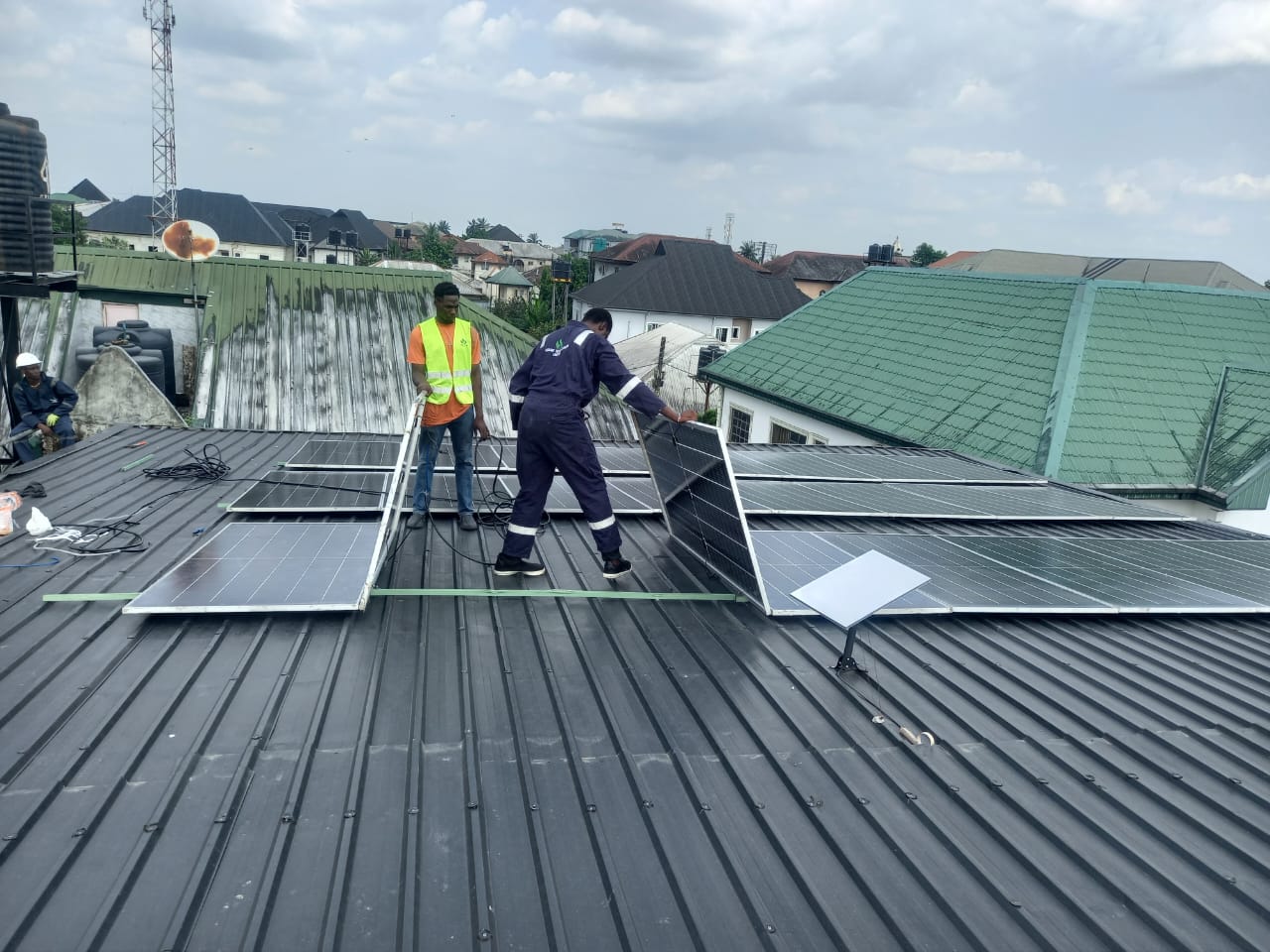
Business has never been as brisk for Nigerian solar panel retailer Samuel Okechukwu and his team of installation technicians, who are struggling to keep up with orders since the Iran war caused local fuel prices to double
“There’s too much work, I’m even having to out Climate Home News, as he installed solar panels on the roof of an apartment building in the southern city of Port Harcourt
Before the war, he had installations once or twice a week, but is now busy almost every day
Okechukwu’s surge in orders in recent weeks suggests that more Nigerians are buying solar systems due to soaring fuel prices caused by the conflict in the Middle East, which has effectively blocked the Strait of Hormuz through which a fifth of the world’s oil and liquefied natural gas previously flowed
Plagued by frequent failures on Nigeria’s national grid, many homes and businesses buy diesel and petrol to supply generators to keep the lights on and equipment operating
Business has never been as brisk for Nigerian solar panel retailer Samuel Okechukwu and his team of installation technicians, who are struggling to keep up with orders since the Iran war caused local fuel prices to double
“There’s too much work, I’m even having to out Climate Home News, as he installed solar panels on the roof of an apartment building in the southern city of Port Harcourt
Before the war, he had installations once or twice a week, but is now busy almost every day
Okechukwu’s surge in orders in recent weeks suggests that more Nigerians are buying solar systems due to soaring fuel prices caused by the conflict in the Middle East, which has effectively blocked the Strait of Hormuz through which a fifth of the world’s oil and liquefied natural gas previously flowed
Plagued by frequent failures on Nigeria’s national grid, many homes and businesses buy diesel and petrol to supply generators to keep the lights on and equipment operating
Even before the latest fuel price shock, solar installations had been increasing in Nigeria in recent years as an alternative to generators among those able to afford the initial outlay.
It costs about 600,000 naira ($450) to buy just one inverter battery and two 300-watt solar panels to charge it – roughly 10 times the minimum monthly wage – and eyebrows were raised when the government announced last year that the presidential villa was being kitted out with a $6 million solar mini-grid
Nigeria’s erratic power supplies have become even more unreliable in recent weeks as gas shortages constrain already fragile power generation. Most of Nigeria’s electricity supply comes from gas-fired plants

Last month, the Nigerian Independent System Operator said several of the oil- and gas-producing nation’s thermal power plants were being affected by “persistent gas supply constraints” that were causing a decline in electricity generation
While Nigeria has abundant gas reserves, the shortages are largely driven by structural issues, including mounting government debts owed to gas suppliers and pipeline constraints. Power Minister Adebayo Adelabu said last week that gas suppliers are prioritising export markets which have become more attractive and offer better returns over domestic markets
This week, the Nigerian government increased gas prices for power generation companies, a move likely to deepen cost pressures in the electricity sector already struggling with debt and supply shortages
At the same time, Okechukwu said rising temperatures in recent years were also increasing demand for an affordable
Installations of solar power in Africa jumped 54% in 2025, according to a report by the Global Solar Council (GSC), marking the fastest annual growth on record
The continent’s solar power capacity still represents only about 1% of the world’s total, though industry experts say the continent may have significantly more than official data reflects, with many rooftop installations going uncounted
Precarious power supplies are already a key driver of solar adoption in many African nations, propelling fast growth rates in countries including Nigeria, which was Africa’s second-largest solar installer last year, installing more than 800 MW of capacity, according to the GSC, a nonprofit trade body
Surging energy costs due to the Iran war could give further momentum to growth, the GSC’s CEO Sonia Dunlop told Climate Home News
“It’s clear the people of Nigeria saw the writing on the wall … and have gone all in on rooftop solar as a result,” Dunlop said
The increase in energy prices since the conflict began have cost consumers and businesses around the world more than $100 billion, according to a March 2026 analysis by 350.org, a non-profit organisation
It said that would be enough to build sufficient solar capacity to supply about 150 million people in lower-consumption countries, for example in Africa, adding that investing in renewables was the best way to stabilise prices and strengthen energy security
Anne Jellema, 350.org’s CEO, urged governments meeting in Colombia next month to discuss the transition away from oil and gas to “seizethis moment to adopt binding targets to phase out fossil fuels and ramp up investment in a clean, safe energy future”
Africa records fastest-ever solar growth, as installations jump in 2025
The global energy shock unleashed by the U.S.-Israeli war“definitely supports the case for longer-term mitigation, not being reliant on imported oil”, said Karl Boyce, CEO of ARC Power, a mini-grid developer operating in Africa, adding that securing sufficient investment would be crucial to realising Africa’s renewables potential
“It’s so reliant on really heavy investment,” Boyce said. “So globally, there should be a focus on seeing how more investment can go into that sector just to give more stability in the longer term.”
In Port Harcourt, another solar trader, Sunday Onuchukwu, said his business has been “moving faster than before” as people get tired of power cuts and rising fuel costs that make investing in panels seem a better bet
Located in a solar panels retail market, Onuchukwu’s shop was busy with customers, but the market itself was unusually quiet – without the usual whirr of generators thanks to the solar panels on the roof
“Most of my customers complain that the fuel issue is one reason why they have decided to go solar. I have clients who transition both their offices and homes at the same time and move away from the bad power supply,” Onuchukwutold Climate Home News
He said many businesses spend more than 20,000 naira ($15) per day on petrol to power generators
Green Climate Fund picks locations for five developing country hubs
“With that money, calculated over a one-year period, you can install solar and forget about ever buying petrol,” he said, adding that some lower-cost solar products were now becoming available such as a 50,000-naira ($36) kit that provides enough power to light a single bulb and charge a mobile phone
Lifting two heavy panels onto his headin Onuchukwu’s shop, one customer said ensuring a steady supply of power – after months without mains supplies – was vital for his barber shop and would also help his wife’s small business
“This is what I am using to run my business and ensure electricity,” the man said, giving his family name as Amadi
“With these two panels, I can also power my wife’s inverter freezer for her to be selling frozen foods.”
TAGS:Energy transition, Gas, solar panels

