

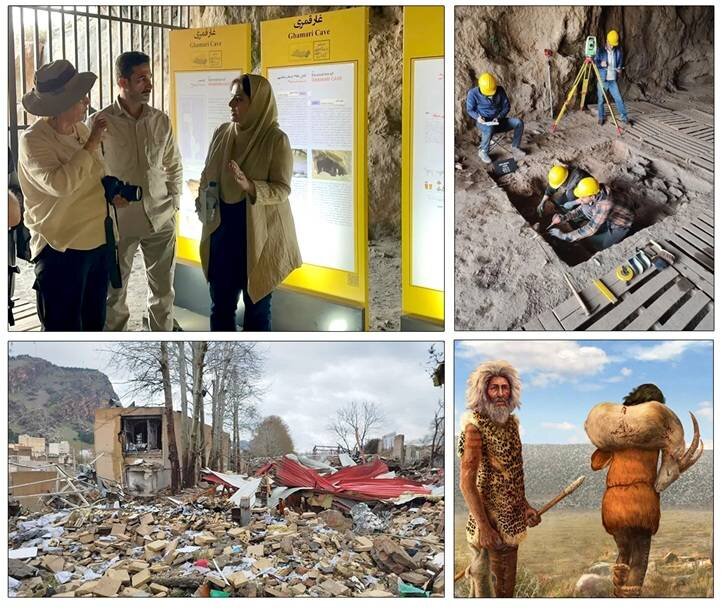
This week marks the first anniversary of a milestone that reshaped how the world sees Iran’s ancient past. On July 11, 2025, during the 47th session of the UNESCO World Heritage Committee in Paris, the Paleolithic Sites of the Khorramabad Valley were inscribed on the World Heritage List—Iran’s 29th such site, and its first ever dedicated to the Paleolithic period.
A year later, the inscription still resonates, both within Iran and across the wider archaeological community, cementing the valley’s place among Southwest Asia’s most important prehistoric landscapes while spurring new research, conservation work, and cultural tourism throughout Lorestan province.
The inscribed property—originally proposed under the broader title “Prehistoric Caves and Falak-ol-Aflak Ensemble”—was ultimately recognized in a more focused form: six of its most significant components. These are the caves of Kaldar, Ghamari, Gilvaran, Yafteh, and Kunji, along with the Gar Arjeneh rock shelter. Together, they trace a long, narrow karstic valley through the Central Zagros Mountains, forming an ecological and climatic corridor that has guided human movement and settlement for tens of thousands of years. Abundant water, rich fauna and flora, and a wealth of natural shelters made this valley a magnet for human populations as far back as 60,000 years ago—and likely longer.
The nomination rested on more than half a century of prior research, but it gained fresh momentum from investigations undertaken specifically to answer questions raised by ICOMOS, UNESCO’s advisory body. Chief among these was the excavation at Ghamari Cave in early 2025, launched to clarify the site’s cultural sequence. What researchers found exceeded expectations: remarkably well-preserved Neanderthal occupation layers, complete with lithic assemblages and faunal remains bearing clear signs of butchery and fire use. Concentrations of charcoal offered direct evidence that Neanderthals controlled fire here, while later strata revealed Chalcolithic-era pastoral activity—a vivid record of adaptation stretched across tens of thousands of years. The excavation drew significant international attention and became a cornerstone of the UNESCO dossier.
The valley earns its Outstanding Universal Value chiefly through UNESCO’s Criterion (iii)—bearing exceptional testimony to a cultural tradition or civilization. Few places on Earth preserve so clear a record of the transition from the Middle to the Upper Paleolithic, the period when anatomically modern humans arrived in the Zagros and replaced the Neanderthals who had lived there for millennia. The Mousterian layers at Kunji Cave speak to that earlier Neanderthal presence, while Yafteh Cave holds the most complete evidence anywhere of the Baradostian culture, the region’s earliest Upper Paleolithic tradition. Here, archaeologists have uncovered some of Iran’s earliest known expressions of symbolic thought: pendants carved from red deer canines, marine shells carried from the distant Persian Gulf, and traces of ochre use. Paired with a sophisticated stone tool industry, these finds testify to the cognitive and technological depth of the people who made them.
At the heart of preserving and presenting this heritage stands the Archaeological Museum of Lorestan, housed within the historic Falak-ol-Aflak Citadel in Khorramabad. The museum functions as the primary home for the very artifacts that anchored the UNESCO nomination, and its prehistoric gallery in particular offers a direct window into the finds unearthed from the valley’s caves and rock shelters. In many ways, the museum completes the story that the World Heritage sites themselves can only begin.
Spread across four sections and 224 square meters, the museum guides visitors through more than one hundred thousand years of human habitation. The journey opens with an overview of Lorestan’s prehistory—a detailed map of archaeological sites organized by period, a look at the valley’s geomorphology, and a striking diorama depicting a Neanderthal flaking stone beside a child. From there, the collection’s 185 paleontological and archaeological specimens take center stage: fossilized Late Miocene herbivores from the Dimeh Valley, over seven million years old, alongside Middle Paleolithic stone tools exceeding 100,000 years in age from Houmian and the UNESCO-listed caves of Ghamari, Kunji, and Kaldar—tools attributed, with high confidence, to Neanderthal populations. The Upper Paleolithic gallery showcases finely made points, scrapers, and bone awls from Yafteh Cave, dating to 30,000–40,000 years ago and marking the arrival of Homo sapiens in the region. Epipaleolithic tools from Pa Sangar illustrate the shift toward the Neolithic, evidenced by domesticated goat bones and a notably deformed human skull, some 9,000 to 10,000 years old, from Tepe Abdolhossein. Chalcolithic finds from the Seymareh Valley—including a child’s fetal burial within a ceramic vessel and painted pottery depicting a group dance—offer a rare and moving glimpse into early ritual life. To strengthen the museum’s case for the UNESCO bid, roughly eighty significant artifacts were permanently transferred from the National Museum of Iran, including pieces drawn from the very caves now recognized as World Heritage sites. This curation gave the museum the material means to demonstrate the valley’s uninterrupted occupation and its Outstanding Universal Value—playing no small role in securing Iran’s 29th World Heritage inscription in July 2025.
The redesign of the museum’s galleries drew on the expertise of leading figures at the National Museum of Iran and Lorestan ICHTO. Fereidoun Biglari, head of the museum’s Paleolithic Department, designed and arranged the Paleolithic section of the prehistory gallery. The later galleries—spanning the Neolithic through the Islamic era—took shape with guidance from Ata Hasanpour, archaeologist and director of Lorestan ICHTO and Jebrael Nokandeh, archaeologist and director of the National Museum of Iran. Under their direction, the museum’s four sections cohere into a single narrative: the story of human adaptation, from the valley’s earliest inhabitants more than 100,000 years ago to the complex societies of the historical period. The resulting institution functions simultaneously as an exhibition space for regional heritage and as a substantive educational apparatus, effectively reframing Lorestan’s past not as an isolated case study, but as an integral component of humanity’s collective cultural patrimony.
The inscription’s effects have already been felt. A commemorative stamp was unveiled at Falak-ol-Aflak Castle, featuring imagery from the 2025 Ghamari Cave excavations, the rock shelters at Gilvaran and Gar Arjeneh, and an artistic reconstruction of Upper Paleolithic hunters at Yafteh Cave. In February 2026, the National Museum of Iran held a ceremony marking the inscription, and plans are now underway for a dedicated cave museum in Khorramabad. These efforts reflect a broader ambition: to build sustainable tourism, draw cultural investment, and create employment in handicrafts and services. The listing places Iran among a distinguished group of nations safeguarding Paleolithic heritage as part of humanity’s shared legacy—alongside France’s Vézère Valley, Spain’s Altamira, China’s Zhoukoudian, and India’s Bhimbetka.
Looking forward, the World Heritage Committee and ICOMOS have urged Iran to continue its scientific research, establish an annual calendar for archaeological excavation, and adopt non-invasive technologies for standardized documentation. The successful inscription of the Khorramabad Valley reflects decades of dedicated research and national collaboration, affirming Iran’s essential place in the human story—and offering inspiration for future generations to engage with, and protect, our shared past.
