

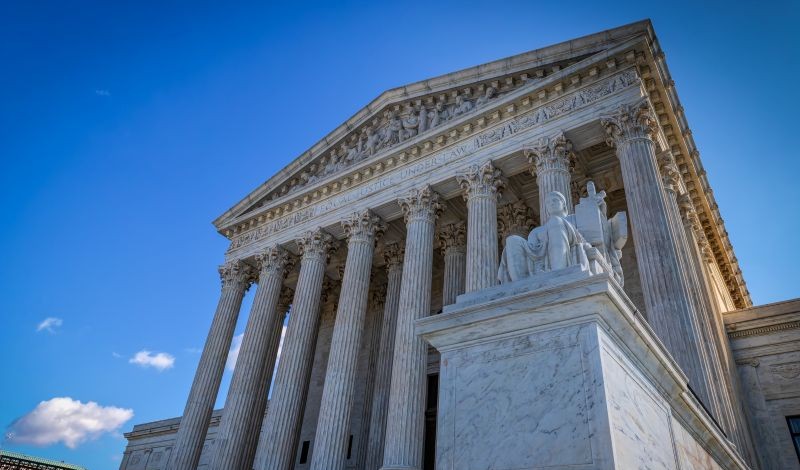
The high Court will confront climate change, judicial review, and other regulatory issues.
Climate change. Veteran’s benefits. Unexploded ordnance from World War II. Each features in the cases that the U.S. Supreme Court will confront now that it has returned from its summer recess.
During the Court’s October sitting, which began when the justices took the bench on Monday, the Court will grapple with administrative-law questions that affect regulation at all levels of the federal government.
One case presents a familiar issue packaged in a new format. Debates about climate change, and how the federal government should respond, have raged over the last few decades. But the very first case the Court will hear—Suncor Energy v. County Commissioners of Boulder County—concerns the extent to which states can respond instead.
The case began in 2018 when the commissioners of Boulder County sued Suncor Energy and Exxon Mobil in a Colorado state court. The commissioners alleged that the companies’ “production, promotion, refining, marketing and sale of fossil fuels” contributed to greenhouse gas emissions that increased the number of extreme weather events, such as fires and floods, faced by the county. They argued that the companies’ activities violated Colorado’s unwritten common law as well as the Colorado Consumer Protection Act.
The question before the justices concerns whether those state laws can regulate the companies’ activities. The companies had argued before the Colorado Supreme Court that federal law prevents the state-law-based claims because the federal Clean Air Act already governs the same conduct. The Colorado Supreme Court rejected that argument.
If the U.S. Supreme Court agrees, it would provide states greater leeway to discourage conduct resulting in greenhouse gas emissions. Such leeway would come not a moment too soon for climate change advocates as the federal government rescinds emissions standards, although some advocates dispute whether Colorado’s laws truly regulates emissions. Opponents, however, criticize the lawsuit for allowing “Colorado to penalize a company for conduct outside of its borders.”
The Court recently announced that Justice Samuel A. Alito, Jr., will no longer participate in the case. Justice Alito, in an interview with Bloomberg, reportedly described recusal as “the prudent step” based on the arguments made and because his wife owns stock in two companies not part of the current lawsuit but who the Court’s decision will likely affect. Should the justices split along ideological lines, the recusal raises the possibility of a split 4-4 decision if the commissioners can win the vote of one Republican appointee. If that happens, the Colorado Supreme Court’s decision would stand.
Other upcoming cases reprise themes from the last few years.
The justices will hear Johnson v. United States Congress on the same day as Suncor. The case concerns the U.S. Congress’s power to limit federal courts from hearing challenges to agency actions unless the challenger seeks review in a specific court. It involves an incarcerated U.S. Army veteran challenging the decision of the U.S. Department of Veterans Affairs (VA) to cut his benefits. Federal law strictly limits the amount available to incarcerated veterans.
Ordinarily, a veteran in Johnson’s position would challenge that decision following the path Congress set out in the Veterans’ Judicial Review Act. The statute provides for review first by the Board of Veterans’ Appeals, an agency within the VA, then by the U.S. Court of Appeals for Veterans Claims, and then by the U.S. Court of Appeals for the Federal Circuit.
Johnson instead sued the VA in a federal district court. He brought a facial challenge which argued that the benefits-limiting law violates the constitutional rights of all incarcerated veterans. The U.S. Court of Appeals for the Eleventh Circuit, however, held that the Veterans’ Judicial Review Act bars such a challenge. The court noted its decision conflicts with those of other the federal courts of appeals.
A decision affirming the Eleventh Circuit would solidify similar jurisdiction-channeling regimes, which apply in many situations. Federal courts, for instance, have become embroiled in controversies over when federal employees may challenge their terminations in court instead of before the Merit Systems Protection Board. Entrenching the regimes would also force litigants to bring constitutional claims before administrative bodies at a moment when the executive branch has advanced expansive theories of constitutional power and agency independence has reached an all-time low.
The Court may also continue its trend of narrowing the scope of the National Environmental Policy Act (NEPA) in Department of the Air Force v. Prutehi Guahan. NEPA’s requirements, particularly its environmental-review provision, have bedeviled federal agencies for years. The justices held two terms ago that such reviews need not consider the effects of potential future projects.
Prutehi Guahaninvolves the Air Force’s disposal of unexploded munitions on Guam’s Tarague Beach. To continue disposing of the munitions—which it does by either burning or detonating them—it had to apply for a permit under the Re
When it submitted its application to renew its permit, it only followed that law’s separate environmental-review requirements and not NEPA’s. A Guam-based nonprofit challenged the application before it had been approved or denied by the local regulator considering it.
The U.S. Court of Appeals for the Ninth Circuit, in a divided decision, held that the organization could challenge the application itself, instead of waiting for the local regulator’s decision, and that the Air Force had to comply with both sets of requirements.
A decision for the challengers would slightly widen the category of actions subject to judicial review. Doing so, in the government’s telling, would threaten “2500 environmental permits within the Ninth Circuit alone,” an expanse covering much of the western United States. The government also warns that requiring federal agencies to comply with both laws would waste bureaucratic reases
Those interested in how the justices decide each question will have to wait some time, as the Court typically takes several months to decide the cases it hears oral argument on.
Tagged: Administrative Law, Administrative Procedure, agency action, Clean Air Act, environmental law, Environmental Regulation, NEPA, U.S. Supreme Court

