

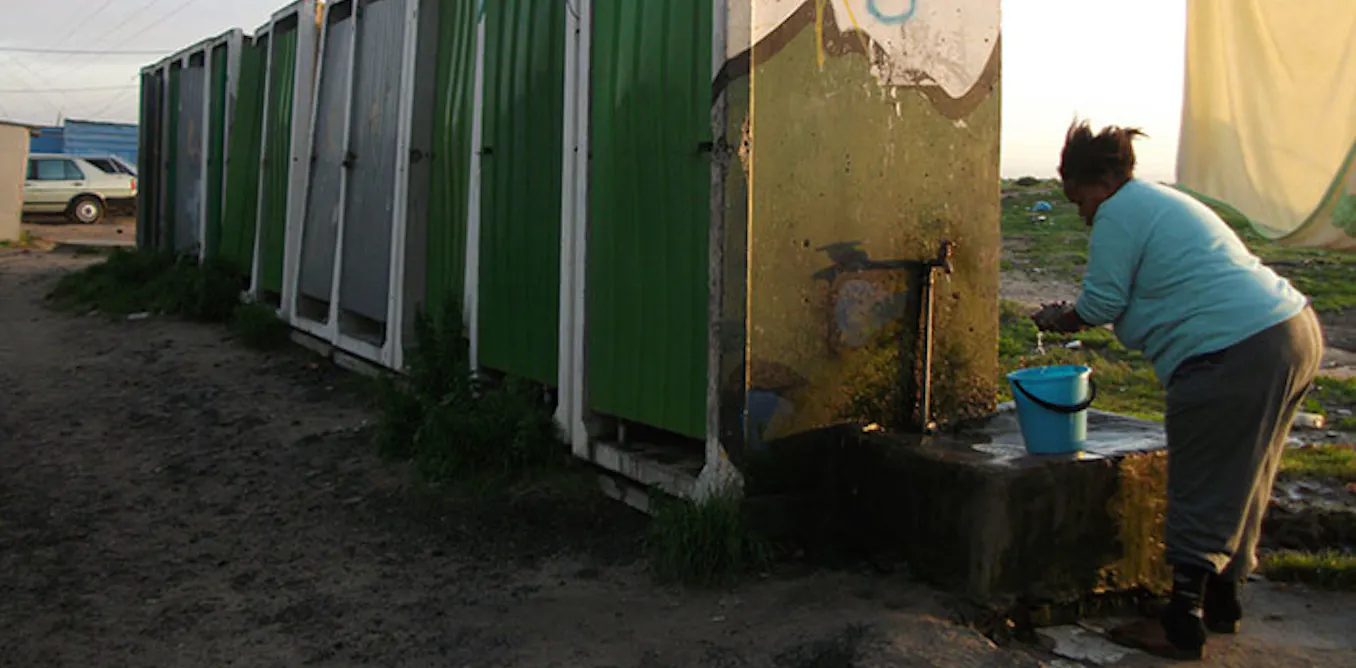
Water affects almost every part of daily life: drinking, sanitation, food production, health, jobs and the natural environment. Yet in South Africa, three million people don’t have clean running water, and 14 million have no flushing toilets.
Climate change and recurring droughts make the problem worse. However, water shortages are not simply about how much water is available. They also depend on how water is managed, maintained and shared.
We are environmental science researchers who used water management as a way to examine two important ideas: sustainable development and environmental justice. In simple terms, sustainable development means meeting people’s needs today without harming the ability of future generations to meet theirs.
Environmental justice means that everyone should have fair access to environmental benefits, such as clean water, and a meaningful say in decisions that affect them.
Our recent paper asked a central question: what is stopping sustainable and fair water management from becoming a reality?
We reviewed research on water management and interviewed 35 people from government, NGOs, academia, agriculture, mining and water services about the challenges of putting water policy into practice. We also surveyed households about their experiences of unreliable or inadequate water supplies.
Our research found that South Africa’s post-apartheid water policy was widely seen as ambitious and progressive because it promises water for all. Yet, three decades on, that promise remains largely unmet.
The problem is not the law itself, but that it has not been properly put into practice. Too much bureaucracy, corruption, weak political commitment, government departments that do not work well together, and a lack of skills and capacity have all slowed progress.
Government departments need to work together better, have the people and rens from the start rather than consulting them after decisions have already been made
South Africa has the laws, but not the services
South Africa’s National Water Act, the country’s key water law, was passed in 1998, four years after the end of apartheid. This was a time when the country’s water system had largely served the interests of a minority, especially white commercial farmers, for decades.
The new law aimed to manage water more fairly and sustainably: protecting water rein decisions about water
Many of the people we interviewed felt that the National Water Act was not standing in the way of water for all. As one person said:
There are an abundance of regulations, acts, policies, frameworks, strategies and plans … they exist in vain if they are not implemented; in most cases they are just a tick-box exercise.
However, one problem is that government funds new water infrastructure but not its upkeep, leaving municipalities to cover maintenance from local revenue. As systems deteriorate from lack of maintenance, replacing them becomes far more expensive: the maintenance backlog is estimated at R400 billion (about US$25 billion), but only R26 billion (US$1.6 billion) has been budgeted.
The people we interviewed described ageing water treatment plants as “dismal”. Water leaks were not repaired quickly, and municipalities struggled to recruit and retain engineers and other skilled workers. A government official we interviewed said remote municipalities found it difficult to attract qualified staff.
The people we interviewed also described poor communication between government departments. Water is closely connected to energy, food production, housing, health and the environment, but departments can work separately, with separate budgets and priorities. This makes coordinated planning difficult.
As one water-service participant put it, food and energy both affect water, so managing them separately “is not logical”.
The people with the least water have the least say
The people we interviewed said they were concerned that some people had far more say over water than others. As one person from government said:
In most cases in South Africa, the stakeholders, particularly the marginalised ones, are excluded from the project planning process and only get involved
once the decision has been made.
Rural communities and small farmers have less access to water infrastructure, information and decision-making than large farms and mining companies. Participants described cases where water pipes ran through or near rural communities without supplying those communities with water. They also spoke of how commercial users had better access to money, technology and established water rights.
We also found that water officials weren’t able to meet farmers’ needs effectively. One person from agriculture said:
We are not seeing much of the government in the systems in place … (recently) we had a lot of floods and there were no systems in place into water management or into water conservation. They didn’t have anyone to report to or to actually intervene in preventing this from happening again.
Trust was another important finding of our research. When people see water infrastructure fail, rules applied inconsistently, or decisions made without their involvement, they can lose confidence that the system works fairly. This can make cooperation harder.
At the same time, our research found examples of community-led projects and organisations working to improve water awareness, repair problems and build local participation.
What needs to happen next
South Africa needs to make its water policies and laws work in everyday life. This can happen by holding the government accountable for maintaining infrastructure, enforcing water rules consistently and investing in the people and skills needed to deliver services. Decisions about water must be transparent, so people can understand how and why they are made.
Just as importantly, water management cannot be solved by government alone. Communities, farmers, industry, NGOs, researchers and water providers need regular opportunities to work together on real local decisions — not only to be consulted occasionally after decisions have already been made.
Rural communities and smaller water users must have a meaningful voice alongside more powerful organisations. As one NGO representative told us:
That’s the best policy, localised, even per city per town, and you are able to have every department … on one platform to discuss how to protect the water resource.
Fair and sustainable water management matters to everyone. It protects health, supports livelihoods and food production, reduces environmental damage, and helps ensure that the benefits of South Africa’s water re

