

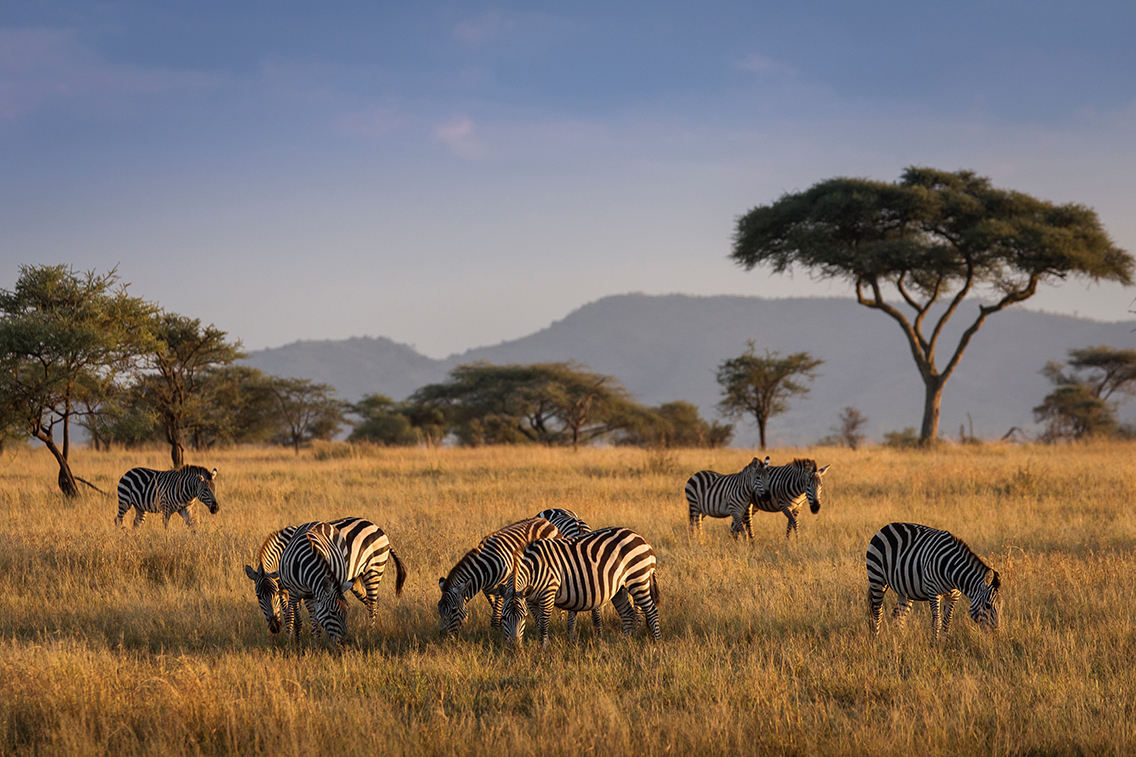
At Mara crossing number five near Kogatende, there is no way through. A wall of four-wheel-drive vehicles blocks a herd of wildebeest from reaching the river. The animals turn towards the neighbouring crossing, number four.
Immediately, the vehicles race off too. It is July 2025, the dry season in Serengeti National Park in northern Tanzania. The animals need a route across the water. The guides want the best view.
At the next crossing, the approach is narrow, with dense vegetation on one side. A bridge upstream has been washed away, concentrating vehicles on one bank.
Drivers form several rows and push beyond the markings. Visitors get out, film and pose for selfies. Some wildebeest turn back; others divert onto steep banks.
From the opposite bank, safari guide Nick Kleer shouts for people to return to their vehicles and give the animals space. In his estimation, this difficult spot could accommodate about 10 vehicles. Kleer counts 156.
Serengeti National Park turned 75 in 2026. Tanzania’s Tourism Ministry recorded more than half a million visitors to the Serengeti in 2024, around two-thirds from abroad.
Their spending helps finance conservation and provides jobs and income. But the business depends on animals being able to feed, breed and move through the landscape. Roads, lodges and safari traffic increasingly affect how animals use that landscape.
Serengeti shall not die
The park was designated in 1951 under the British administration of Tanganyika, then a UN trust territory. Bernhard and Michael Grzimek’s wildlife surveys, followed by the 1959 film and book Serengeti Shall Not Die, helped draw international attention to the migration and support for its protection.
For Maurus Msuha, Tanzania country director for the Frankfurt Zoological Society, the achievement is an ecosystem that still functions: wildebeest and zebras migrate over long distances, habitats remain connected, and many wildlife populations are stable or increasing.
Tourism is one of several pressures on that system. Grant Hopcraft, a migration ecologist at the University of Glasgow, identifies the Mara River as his foremost concern.
More than a million animals depend on its water during the dry season, while agricultural abstraction and vegetation loss affect its catchment. Growing demand for land around the ecosystem fragments habitats; changing rainfall and climate add further pressure. Msuha stresses that these changes can reinforce one another, including developments beyond the national park’s boundaries.
For the tourism industry, the concentration of visitors is the immediate management problem. Virginia Messina, group chief executive of the African Travel and Tourism Association, acknowledges crowding at particular sightings and popular locations. She favours measures suited to individual places and seasons, backed by enforcement of existing rules.
“Tourism is a huge part of the reason the Serengeti remains protected and provides jobs and income,” she says. “Tourism and conservation should not be viewed as opposing objectives.”
Early warning signs
Yet the effects of tourism extend beyond crowded riverbanks. Hopcraft has tracked wildebeest with transmitters since 1999. His long-term data show a decline in the probability of collared animals crossing the Mara. He regards altered movement as an early warning, before a population decline becomes apparent.
In neighbouring Kenya’s Maasai Mara, a colleague reported counting 250 vehicles at one crossing and said numbers could reach 500 on some days.
“The issue with that, though, is that by the time you count the wildebeest and establish you’ve got a problem, you’re too late,” he says. “You can think of it as an animal voting with its feet.”
Research published by Hopcraft and colleagues in June 2026 examines how buildings influence wildebeest movements. Their model found effects extending several kilometres beyond the structures themselves.
The estimated effect fell to 5% of its initial magnitude only at about 5.9 kilometres. This is a measure of declining influence, not a boundary within which no wildebeest venture.
Accommodation tends to occupy places where food and wildlife are abundant. Female wildebeest spend much of the year pregnant, nursing or both, and need access to nutritious grazing. Long-term research has identified food availability as the main factor regulating this wildebeest population; starvation kills more animals than predators do.
Buildings and the activity around them can therefore affect access to the re place
Another 2026 study found physiological changes that a visitor watching wildlife beside a lodge would not necessarily see. Biologist Eivin Røskaft of the Norwegian University of Science and Technology and his colleagues investigated stress in impalas, which remain in relatively small areas rather than migrating over long distances.
The researchers collected 213 dung samples around tourist accommodation and measured metabolites of stress hormones. Impalas near large lodges had higher levels than those near permanent tented camps or seasonal campsites.
The difference persisted even when the lodges had no guests. An animal’s apparently relaxed behaviour was therefore insufficient to establish how it was responding physiologically to its surroundings.
Røskaft warns that sustained high stress is unhealthy, but effects on reproduction still need to be demonstrated. The study measured hormonal markers, not a decline in breeding success or population size. Its findings nonetheless make the location and scale of accommodation relevant to conservation, even when visitor numbers temporarily fall.
Pressure on environment
Each additional lodge also generates journeys beyond the game drives its guests take. Food deliveries, laundry, maintenance, waste collection and staff transport add to the traffic, says María Díez-Gutiérrez, a transport researcher at Norway’s SINTEF institute.
Tanzania’s December 2025 report to UNESCO put traffic on the Lodoare–Golini–Seronera route, which leads through Ngorongoro towards the Serengeti, at around 1,500 tourist vehicles a day.
“It is important to look at the Serengeti as a whole system rather than focusing only on individual hotspots,” she says. Reducing traffic at one location may send vehicles elsewhere, including previously quieter areas.
In 2017, Díez-Gutiérrez and colleagues modelled how a proposed northern road connection would redistribute traffic. It would have shifted journeys between routes without reducing the total distance driven across the network they studied. Moving congestion away from a popular site did not necessarily reduce the overall burden.
Improving existing roads can also have unintended consequences. Richard Lyamuya of the Tanzania Wildlife Research Institute and his colleagues surveyed 200 kilometres of gravel roads in the Serengeti ecosystem in 2015.
They recorded more roadkill on wider, busier sections and roads in better condition. Lyamuya identifies speeding as a likely explanation: a smoother surface can encourage drivers to travel faster, leaving less time to avoid animals.
He advocates enforced speed limits, monitoring and penalties, alongside driver education. Díez-Gutiérrez also proposes restricting access to sensitive areas at particular times and monitoring whether management measures reduce both traffic pressure and ecological disturbance.
Tanzania’s decisions about future development must account for these effects alongside the income tourism generates.
A joint UNESCO and International Union for Conservation of Nature mission in 2024 recommended scientifically grounded, measurable limits for tourism. Its assessment recognised that the migration and the site’s World Heritage values remained intact, while warning about the cumulative pressure of infrastructure and visitor activity.
In its December 2025 report to UNESCO, Tanzania said it had halted new infrastructure construction pending a revised general management plan. A Sustainable Nature-Based Tourism Model was intended to inform that revision. The reported pause should not be read as a blanket end to development: UNESCO subsequently identified unresolved concerns about the Fort Ikoma golf course and road-hardening plans.
For Msuha, the starting point is the ecosystem’s ecological limits. Long-term tourism depends on an intact Serengeti. Decisions about the density and location of camps, roads and vehicles must follow from what the landscape can sustain, rather than visitor growth alone.
He also stresses that benefits and costs are unevenly distributed: people living alongside wildlife do not always share equally in the economic returns from tourism.
Hopcraft likewise sees tourism as a potentially sustainable use of a natural re priority. The dividend of good conservation is very good economics.”
Messina’s stated objective is “high-quality, low-impact wildlife tourism”.
Asked about the Serengeti at its centenary, Hopcraft distinguishes the survival of a protected area on a map from the survival of its ecological processes. “And so, I have no doubt Serengeti will still be there, defined by its boundaries. I just hope it’s there in the ecological sense that has always been there for the last several thousand years.”
Roman Goergen is a German freelance science, nature, and conservation journalist based in London.
Africa on its own terms, in your inbox every week.

