

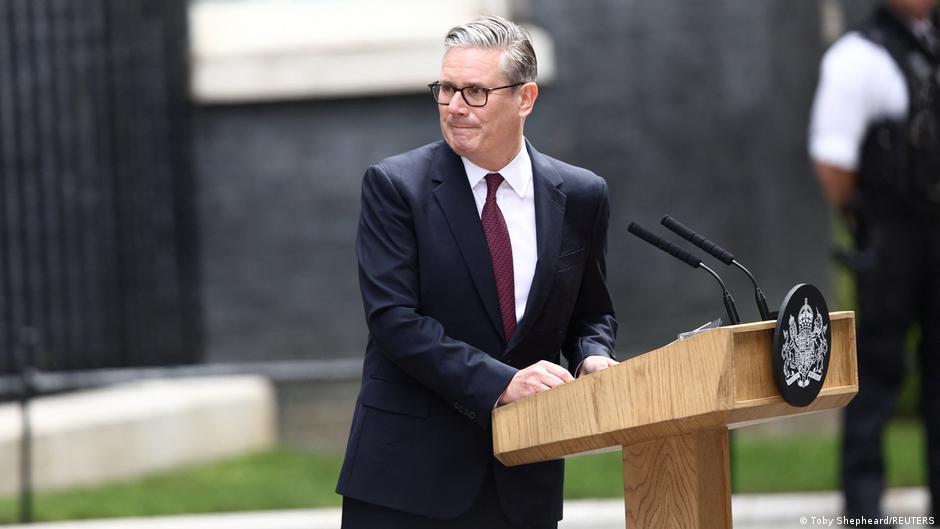
Outgoing United Kingdom (UK) Prime Minister Keir Starmer walked into Downing Street in July 2024 on the back of one of the Labour Party’s strongest election victories in decades. He pledged to restore Britain’s global credibility after years of Brexit upheaval and shrinking aid budgets. Africa featured prominently in that pitch: a continent of rising strategic, economic and geopolitical importance
The message was clear. Labour would fundamentally change how it relates to the African continent, focusing on partnership, not paternalism; investment, not dependency and this time, the UK was in for the long-term engagement. For many across African capitals, it felt like a reset
Then came Starmer’s resignation in June 2026, less than two years after entering office, which left African countries again asking whether UK engagement can ever outlast political cycles In the first months of Starmer’s premiership, engagement with Africa intensified. South Africa became an early focal point. A UK presence at the G20 summit, alongside high-level visits and bilateral talks, signaled renewed intent. Trade, infrastructure and innovation dominated discussions, with particular attention to small business support, tech hubs and rail-sector reform through British expertise
African start-ups, especially those from South Africa and Nigeria, kept appearing at major events, such as the London Tech Week. In March 2026, Nigeria’s President Bola Tinubu made a historic two-day visit to the UK, where he was hosted by King Charles III. He secured an economic partnership deal to upgrade the Nigerian ports and deepen cooperation in the fight against Islamist insurgents.
But beyond the announcements, delivery lagged. Many of the initiatives launched with fanfare struggled to translate into measurable outcomes. The gap between ambition and execution widened quickly
The ‘reset’ that stalled
Labour officials framed the new Africa policy as a shift from aid-dependence to a model built on climate cooperation, energy transition, and critical minerals—sectors where Africa’s global relevance is rapidly growing
Nigeria’s President Bola Tinubu’s official visit to the UK was the first by a Nigerian leader in more than three decades
Yet that strategy was hit by internal reshuffles, which diluted focus. Russia’s war in Ukraine and the conflict in the Middle East between Israel, the US and Iran, gradually pushed Africa out as a strategic priority. As a result, momentum slowed as policy attention drifted elsewhere
At the same time, fiscal reality set in. The UK entered this period with reduced international development spending, a trend dating back to 2020, when aid fell from 0.7% to 0.5% of gross national income, and is now expected to drop further to 0.3% by 2027 to fund increased defense spending
Domestic politics greatly impacted foreign policy choices. Starmer’s government struggled with internal party divisions and declining political capital—factors that led to his resignation
Andy Burnham is widely expected to become the next UK prime minister, but it’s unclear if Africa will be a priority for his government
Amid economic stagnation, the UK moved to deepen ties with closer and wealthier markets—the European Union (EU) and Gulf states—where trade gains could be realized more quickly
Africa, by contrast, slipped down the ladder. Not abandoned, but deprioritized
This pattern has precedent. Africa has only intermittently occupied a central place in UK foreign policy, most notably during the Tony Blair years, when development and diplomatic engagement reached their peak. Outside those periods, attention has tended to fluctuate, often driven more by domestic pressures than by long-term strategy
Is the UK’s footprint in Africa fading?
The UK is no longer the dominant external player it once was. Its permanent seat on the UN Security Council ensures continued diplomatic relevance, particularly on conflicts and governance issues in Africa. But its financial influence has narrowed compared to other global powers, such as China
However, some key relationships remain steady. South Africa, for example, remains one of the UK’s most significant partners on the continent, with strong trade tiesin sectors such as automotive manufacturing and metals. In 2025, total UK-South Africa trade volume stood at £12.6 billion (€14.7 billion, $17.3 billion), up 13% from 2024
Starmer’s exit creates both uncertainty and opportunity
On the one hand, it disrupts ongoing initiatives and risks further eroding trust in the UK’s commitment to continuity. Major agreements—such as multi-billion-pound strategic partnerships signed with countries like Kenya—now face renewed scrutiny as political leadership changes
But on the other hand, a new prime minister has the chance to reset the reset—to define a clearer, more realistic Africa strategy rooted in collaboration
The upcoming UK presidency of the G20 offers a concrete test. Issues such as energy transition, debt relief, and critical minerals—where Africa is central to global solutions—could anchor a more credible and sustained engagement. Under a new prime minister, this moment could prove pivotal. Whether the UK chooses to re-engage with Africa with seriousness and consistency—or allow it to drift down the list of priorities once again—will shape the next chapter in this relationship

