

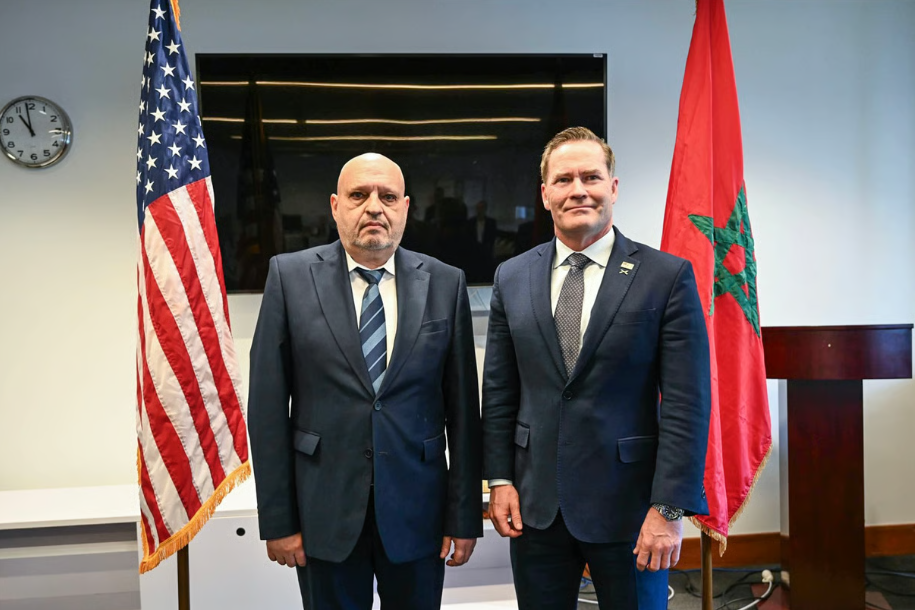
US permanent representative to the UN Mike Waltz visited Rabat on 16 and 17 November, a trip that went far beyond a bilateral diplomatic exercise. He travelled to Morocco in the wake of an episode that laid bare the world’s new fault lines: Russia’s veto of 30 October of a US draft resolution on the UN Mission for the Referendum in Western Sahara (MINURSO).
Waltz’s trip signals Washington’s clear intent to stop the political process from stalling and to take back control of the diplomatic timetable.
READ MOREIn Rabat, US envoy Mike Waltz sets out next steps for Western Sahara
His meeting in Rabat on 17 November with Alexander Ivanko, the Russian official tasked with leading MINURSO’s liquidation and withdrawal, gave the visit particular weight, coming just days after Washington and Moscow clashed indirectly in the Security Council.
Waltz made the orderly departure of the 158 unarmed military observers a priority. But behind this operational coordination lies a far more strategic question: who will set the rules of the game once the UN presence is gone?
Double failure in New York
The 30 October vote brought the balance of power into the open. The US draft resolution received 11 votes in favour, but the Russian veto blocked its adoption. Moscow’s rival draft won only three. This double failure reveals a basic reality: Washington has a diplomatic majority behind its approach, but Moscow keeps the power to block any change it sees as against its interests. The dispute is as much about the substance of a settlement as about each power’s ability to shape how the process works.
For the US administration, the challenge is to turn its support for Morocco’s autonomy proposal into political momentum, now that Resolution 2797 has made it a framework for negotiation. In <a href="https://absafricatv.com/kpmg-global-tech-report-2026/” title=”KPMG Global tech report 2026″>2026, talks in Washington and Madrid between Morocco, Algeria, Mauritania and the Polisario, the national liberation movement representing the Sahrawis, dealt with concrete issues: local governance, re
READ MORELeaked: Morocco’s ‘irreversible blueprint’ for Western Sahara autonomy
In Rabat, Waltz confirmed that the US wants to press on with these efforts. The message is clear: the status quo is no longer seen as acceptable.
Russia sees things differently. Its veto, which it justified by rejecting what it regards as a predetermined settlement, also reflects its wish to protect its influence in multilateral forums. In an Africa where Moscow is strengthening its diplomatic and security positions, notably in the Sahel, letting Washington redraw the political framework of a strategic issue on its own would set a precedent. Western Sahara thus becomes another arena for great-power rivalry, though it cannot be reduced to their confrontation alone.
This episode should also be seen against the map of US interests. Waltz came to Morocco after a visit to Lebanon: two different theatres, but the same concern for security arrangements, alliances and crisis management. For Washington, the kingdom is a leading military and diplomatic partner, at the junction of the Atlantic, the Mediterranean and Africa. Amid instability in the Sahel and competition over infrastructure, resources and shipping routes, Morocco’s Atlantic coast is gaining geo-economic importance.
The centre of gravity has shifted
The challenge remains that of a credible regional negotiation. Given its central role and involvement in the issue, Algeria remains an indispensable party to any settlement. But the key question is whether those involved can move beyond entrenched positions, open a substantive dialogue and examine the conditions for a lasting compromise. That is the test by which the real reach of the US initiative will be judged.
READ MOREMorocco and US accelerate military alliance, leaving Algeria in the cold
For Rabat, the task now is to consolidate its diplomatic gains, keep up the drive for development and investment in the southern provinces and prepare for the balance of power after MINURSO. The end of a UN mission cannot on its own settle a dispute or guarantee a stable new regional order. Rather, it marks a shift in the issue’s centre of gravity: from international monitoring to building a lasting political solution, consolidating economic realities on the ground and redefining regional balances.
The Waltz-Ivanko meeting sums up this new phase: the powers disagree on the terms of a settlement, but already have to deal with its consequences. The real question is no longer just the future of MINURSO, but the diplomatic order that will replace it.

