

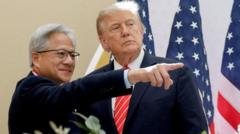
(ABS NEWS) Nvidia’s board reinstated Jensen Huang as president, CEO and board director on Nov. 23 after saying it had “received input from senior levels of the United States government,” and President Donald Trump said he had intervened, telling CNBC he “spoke to them … and I convinced them.”
The company issued a statement saying the board was “confident that Mr. Huang’s reinstatement poses no national security risk.” The board’s reversal came just days after Huang resigned on Nov. 12 amid media reports of extramarital relationships and allegations tying one reported partner to Chinese intelligence, matters that U.S. officials have said raised security concerns.
Trump publicly claimed credit in a Monday interview, saying the administration had provided assurances about national security. Reporting indicates the White House’s communications with the board factored into the company’s decision, but the specific content, participants and timing of those contacts have not been publicly documented beyond the president’s remarks and the board’s statement.
The market reaction was immediate: Nvidia shares closed up about 31% on Nov. 23, a surge that added roughly $0.95 trillion to $1 trillion to the company’s market value and helped push major U.S. indexes higher, reversing recent losses, according to contemporaneous market reports.
The reinstatement and the president’s comments prompted swift bipartisan calls for oversight from Congress. House and Senate committees have sought testimony and answers: three House committees requested a closed-door interview with Huang on Dec. 1, and the Senate Banking Committee scheduled a public hearing for Dec. 3, according to reporting on congressional actions.
Lawmakers and party leaders criticized the apparent White House involvement. House Democratic Leader Hakeem Jeffries called the decision “indefensible, irresponsible and incomprehensible” and said Congress would investigate, and other senators and representatives demanded clarity about what input the administration provided and who authorized it.
Separately, the Commerce Department moved to add Singapore-based Megaspeed and several affiliated firms to the Bureau of Industry and Security’s Entity List on Nov. 23, a formal export-control measure reported by government and media sources. Justice Department officials are pursuing a criminal investigation into Megaspeed, which U.S. officials have linked to concerns that informed earlier inquiries.
News accounts say Nvidia placed Megaspeed on an internal no‑sell list in 2025 and that Commerce has been examining Megaspeed since 2024. The recent Entity List action is part of that multiyear regulatory and law-enforcement effort.
Media reporting also reviewed presidential financial disclosures showing that since returning to the White House Trump has bought and sold Nvidia shares, with aggregate purchases over the past two years reported in a wide range. Those disclosures have prompted questions about whether the president’s private financial interests intersected with public efforts; there is no publicly released evidence establishing a direct causal link between Trump’s personal trading and any particular policy action.
Several details in the public record remain unverified. The allegation that a reported partner in Huang’s resignation has ties to Chinese intelligence is described in news coverage as an allegation under investigation, not as established fact. And while the Nvidia board said it received government input, the company did not identify the officials involved or provide documentation of the conversations.
The rapid reinstatement — a reversal of an earlier board decision not to reinstate Huang — and the involvement of senior U.S. officials have created a rare convergence of corporate governance, national-security concerns and political controversy, with market volatility and regulatory action unfolding simultaneously.
Subscribe to our breaking news bulletin

