

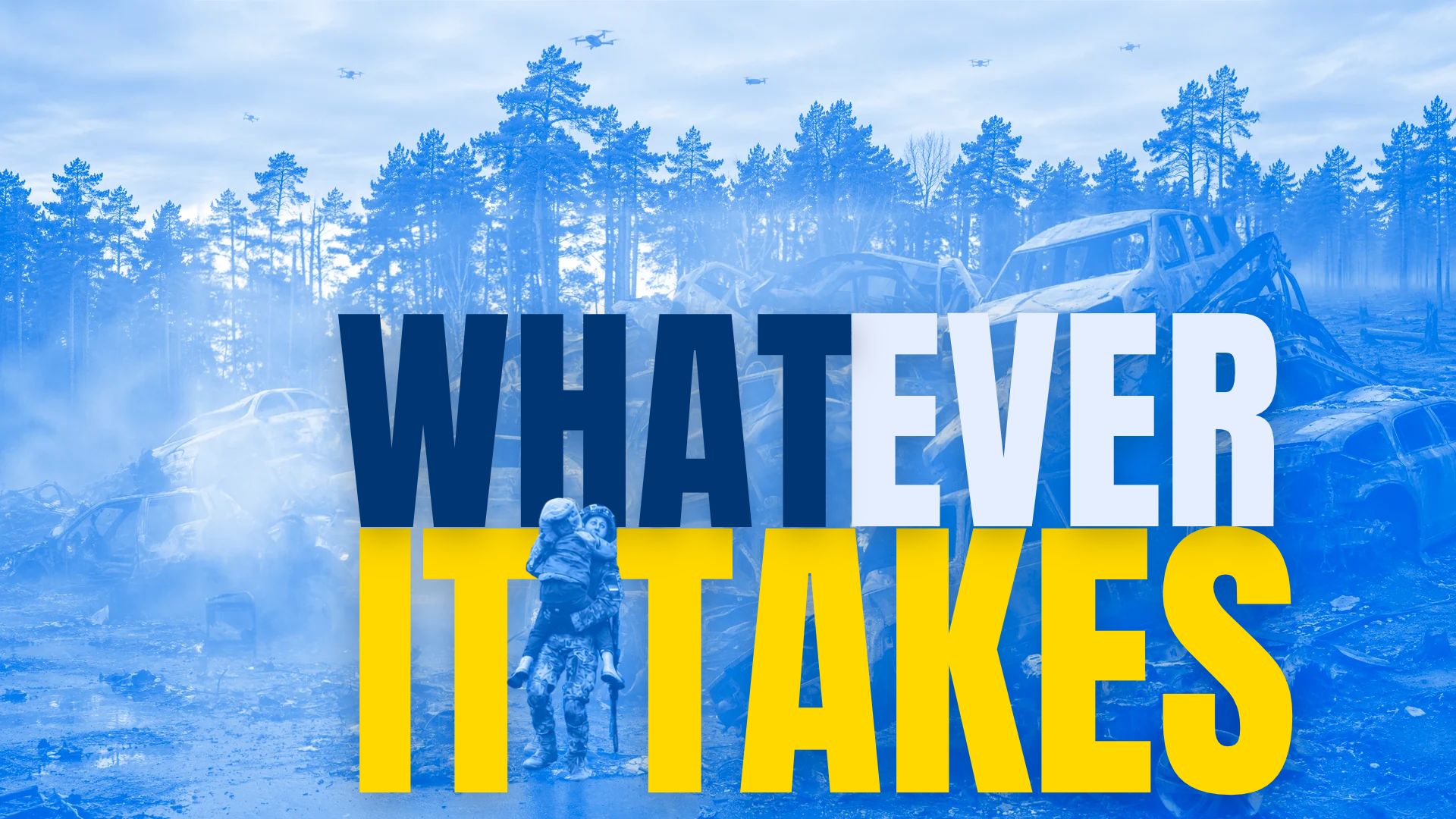
Today, Friends of Europe’s Ukraine Initiative and the European Young Leaders (EYL40) network are launching Europe Defends with the “Whatever it takes” manifesto for Ukraine. Former presidents of the European Parliament, former heads of state and former prime ministers have joined European Young Leaders in calling for a decisive, long-term financial and political commitment to Ukraine.
On 26–27 November, EU leaders meet to decide how Ukraine is funded in 2027 and shape the Union’s budget for 2028–2034. We welcome the encouraging signals from the preparations for the summit, including the European Commission’s 18 November proposal for a new loan of up to €45 billion for 2027, so trust the summit can be turned into Europe’s “whatever it takes” moment for Ukraine: a clear, multiyear commitment that tells Moscow, Kyiv, our allies and our own citizens that Ukraine cannot and will not run out of means if a sustainable peace is the ultimate objective, and that Europe will not run out of breath. We call upon our leaders to confirm the current ambitions towards Ukraine, to speed up delivery, to start using the Russian assets as a lever and to more clearly explain the importance of those decisions to our citizens.
Helping Ukraine is not charity. It is self-defence – and Europe is sitting on €210 billion of frozen Russian money that should also be paying for it today.
Read the full manifesto below. Sign it and support the EuropeDefends campaign here.
Stop calling it foreign aid. Russia’s war is no longer something happening on a map a thousand kilometres away – it is already inside our airports, our power grids, and the delivery vans outside our front doors.
Picture sitting on a runway in Brussels, Liège, Copenhagen, Oslo, or Munich while unidentified drones force the airport to shut down. Picture a parcel catching fire inside a courier depot in Leipzig or Birmingham because Russian intelligence rigged it with an incendiary device meant to bring down a cargo plane. In Germany alone, police logged 165 suspected sabotage cases and 747 suspicious drone sightings in just eight months. Russian-linked hackers have pushed Poland’s power grid to the brink of a blackout, hit heating and water plants in Sweden and Denmark, and mapped the undersea cables off Britain that carry our bank payments and hospital records. Russian missiles are landing on Polish soil.
More than 150 Russian sabotage and cyber operations have struck European soil since 2022. Moscow is testing how much fear and disruption ordinary Europeans will swallow before we look away – while whispering that helping Ukraine costs too much.
Calling support for Ukraine “charity” is the biggest lie in Europe today. You do not give charity to the firefighter standing between a spreading blaze and your own home. Every air-defence interceptor built in a European factory for Ukraine is the exact same technology needed over Brussels, Leipzig, and Copenhagen – keeping missiles off Ukrainian apartment blocks tonight and off our own cities tomorrow.
What Europe lacks is not money, but nerve. In July 2012, when financial markets bet the euro would collapse, Mario Draghi did not spend a single euro. He simply promised that the European Central Bank would do “whatever it takes” – and the panic vanished overnight because nobody doubted Europe meant business.
Today, the Kremlin is making that exact same bet against us. Vladimir Putin knows he cannot beat Europe in a fair fight, so he is betting on our divisions and inability to act decisively. He is betting that Europeans will grow weary, that governments will bicker over budgets, and that our summits will end in timid half-measures while Ukraine bleeds$190 million a day just to stay alive.
The excuse that Europe cannot afford to stop him does not survive basic math. The EU produces €18 trillion every year – an economy ten times the size of Russia’s. Supporting Ukraine at €45 billion a year is just one-quarter of one percent of what Europe produces, and it already counts toward the defence targets NATO countries have promised to meet. We do not have a money problem; we have a fairness problem, where northern and Baltic countries carry far more of the load than the rest of Europe.
And cutting aid will not buy us peace. As Nobel Peace Prize winner Oleksandra Matviichuk has warned, peace does not arrive when a country under attack lays down its weapons. What follows is occupation – which does not stop the torture, the abductions, or the terror. It simply makes them less visible as it closes the doors so we no longer have to watch it on the evening news, while we are faced with a battle-hardened Russian army right up to the EU borders.
For nearly five years, Europe has argued over successive funding packages, providing just enough support to prevent Ukraine from losing, but never enough to convince Moscow it cannot win.
Imagine watching your neighbour’s house burn while the arsonist’s own money is locked inside your safe and arguing about whether you can afford to buy water. Right now,€210 billion in frozen Russian state reservessits in European accounts. Leaving Putin’s war chest untouched while Ukrainian families freeze through winter missile strikes – and while Russian agents sabotage European railways, cables, and power grids – is self-harm.
Russia is attacking not only Ukraine’s military but also its economic lifelines, targeting ports, energy infrastructure and agricultural & industrial exports that generate vital foreign currency. As these attacks erode Ukraine’s ability to sustain its own economy, the financing gap grows.
When EU leaders meet on 26-27 November, they can break that cycle with three clear decisions:
- Deliver 2027 funding now, before winter hits harder.Ensure Ukraine’s €70 billion funding gap for next year is closed on time and release the money early so Ukraine can keep the lights on, repair its power grid, and build air defences without interruption
- Lock multi-year support into the 2028–2034 EU budget.Back it with a coalition of willing countries if unanimity cannot be achieved – so neither Ukraine nor European factories are held hostage to a veto every six months.
- Make Russia pay using its own €210 billion.Task the European Commission to make proposals on the use of the frozen Russian state money sitting in European banks, projecting their possible use under enforceable risk-sharing arrangements, also with other G7 countries, that protect Belgium and other exposed countries.
Nor is this money disappearing into a black hole. Under EU defence rules, at least two-thirds of what Europe buys must come from European and Ukrainian factories – meaning the money returns as European jobs, factory orders, and tax revenue. Buying weapons directly from Ukrainian manufacturers – where a Ukrainian artillery system costs roughly half as much as a comparable European one – stretches every euro further. In return, Europe gains the world’s most battle-tested drone technology, a leading role in Ukraine’s $588 billion rebuilding effort, and critical minerals that strengthen Europe’s supply security.
On 27 November, European leaders must back these actions with one unmistakable promise – and invite London, Ottawa, Oslo, Bern, Tokyo, and Washington to stand behind it:
Europe will ensure that Ukraine has the means to defend itself and secure a just and lasting peace. We will provide predictable, long-term financial and military support and act together to ensure that Moscow understands that it cannot achieve its war objectives.
History is rarely kind to leaders who mistook hesitation for caution. Ten years from now, nobody will ask whether Europe had the right budget rules in November 2026 – they will ask why a continent ten times richer than Russia hesitated to stop a war while it could still be stopped outside our borders.
Read more about “Peace, Security & Defence Forum 2027”
Next event
In person & Livestreamed
Area of Expertise
Peace, Security & Defence
Read more about “Moldova’s accession journey: insights on economic governance and modernisation”
Recent event
Online
Area of Expertise
Peace, Security & Defence
Read more about “From lessons to capability: delivering NATO’s next generation force”
Recent event
In person & Livestreamed
Area of Expertise
Peace, Security & Defence
Read more about “Innovation, adaptation and the future force: translating Ukraine’s lessons for NATO”
Recent event
Online
Area of Expertise
Peace, Security & Defence
view all
Read more about “Former EU leaders and presidents join young leaders in call for ‘whatever it takes’ commitment to Ukraine ahead of EU Summit”
Category
News
Area of Expertise
Peace, Security & Defence
Read more about “Let’s make 27 November Europe’s “whatever it takes” moment for Ukraine”
Category
News
Area of Expertise
Peace, Security & Defence
Read more about “A new European Security Order (made in Russia)? Nein, Danke.”
Category
#CriticalThinking
Author
By Jamie Shea
Read more about “From Brexit to partnership: why the EU–UK Summit must deliver”
Category
#CriticalThinking
Author
By Dharmendra Kanani & Ulrike Sapiro
view all
Watch Policy Voices | Election in Hungary: a national vote with European consequences
Area of Expertise
Democracy
Watch Policy Voices | Why is Europe at war and what needs to be done
Area of Expertise
Peace, Security & Defence
Watch Frontline Voices | Women shaping peace and security in Ukraine: personal reflections from the ground
Area of Expertise
Peace, Security & Defence
Watch Frontline Voices | The Women, Peace and Security agenda at 25
Area of Expertise
Peace, Security & Defence
view all
Track title
Scrub through the track
00:0000:00
Stop playback
Video title

