

The Boeing 787 Dreamliner is finally assembled in North Charleston, South Carolina, but describing it simply as an American-built aircraft tells only part of the story.
Its wings are manufactured in Japan, major fuselage sections come from Japan, Italy, South Korea and the United States, its flight-control surfaces are produced in Australia, and its doors, landing gear, engines and electrical systems involve factories across Europe, North America and Asia.
Boeing designed the 787 around one of the most geographically distributed production networks in commercial ats to a single factory, many suppliers deliver large, substantially completed structural sections that are joined together during final assembly
Where is the Boeing 787 finally assembled?
Every new 787 is now assembled at Boeing’s North Charleston site in South Carolina.
Boeing previously operated parallel 787 assembly lines in North Charleston and Everett, Washington, but consolidated final assembly in South Carolina in 2021. The site now handles final structural joining, systems installation, interiors, testing, painting and delivery. Boeing is also expanding the campus to accommodate future production growth.
South Carolina is more than an assembly location. Boeing also undertakes composite fabrication and aft-body manufacturing there before completed sections move into final assembly.
The result is that the 787 is unmistakably a Boeing aircraft assembled in the United States, but much of its physical structure has already travelled thousands of miles before reaching the final production line.
Boeing 787 production at a glance
| Country or region | Main Boeing 787 contribution | Approximate share |
|---|---|---|
| United States | Final assembly in North Charleston, South Carolina; nose and forward fuselage; pylons; aft-body structures; avionics and aircraft systems | Around 50% of aircraft value with Rolls-Royce engines; higher with GEnx engines |
| Japan | Wing boxes; centre wing box; forward fuselage sections; fixed trailing edges and main landing gear support structures | Around 35% of programme workshare |
| Italy | Central and rear-central fuselage sections and the horizontal stabiliser | Around 14% of the airframe |
| United Kingdom | Rolls-Royce Trent 1000 engine option; landing gear, actuation and other aircraft systems | Around 20% by value on some Trent 1000-powered aircraft |
| South Korea | Aft-body structures, flap-support fairings, aft wheel-well bulkheads and raked wingtips | Not publicly quantified |
| Australia | Movable wing trailing edges, including flaps, flaperons and ailerons | Not publicly quantified |
| Sweden | Large cargo doors, bulk cargo doors and access doors | Not publicly quantified |
| Canada | Composite structures, landing gear doors and the Pratt & Whitney Canada auxiliary power unit | Not publicly quantified |
| France and wider Safran network | Landing gear design and integration, braking systems and related components manufactured across several countries | Not publicly quantified |
| Germany, Singapore, China, Mexico, India and others | Engine modules, landing gear production, systems and lower-tier components | Varies by aircraft and supplier |
| Note: All percentages are approximate. Published figures are not directly comparable, as some refer to programme workshare, others to airframe share or estimated aircraft value. The final breakdown also varies according to engine selection and individual aircraft configuration. |
Japan builds the wings and structural heart of the 787
Japan has the largest international role in the Dreamliner’s airframe.
Mitsubishi Heavy Industries manufactures the 787’s composite wing boxes at its Nagoya Aerospace Systems Works. The wing box is the principal load-bearing structure of each wing and is delivered to Boeing as a large completed assembly. MHI describes Japan’s overall 787 programme workshare as approximately 35%, although that figure refers to industrial workshare rather than the finished aircraft’s monetary value.
Subaru manufactures the centre wing box at its Handa plant in Aichi Prefecture. This critical structure connects the left and right wings to the fuselage and incorporates the main landing gear wheel wells before being delivered to Boeing.
Kawasaki Heavy Industries also has a major role, producing forward fuselage sections, the wing’s fixed trailing edge and structural elements associated with the main landing gear. Its dedicated 787 facilities are located at Nagoya.
Japan’s contribution is therefore not confined to individual parts. It includes some of the largest and most structurally important sections of the entire aircraft.
Italy supplies major fuselage sections and the horizontal tail
Italy is the second major international centre for 787 aerostructure production.
Leonardo manufactures the central and rear-central fuselage sections at Grottaglie in southern Italy. These large composite barrels are produced as integrated structures rather than being assembled from conventional aluminium panels.
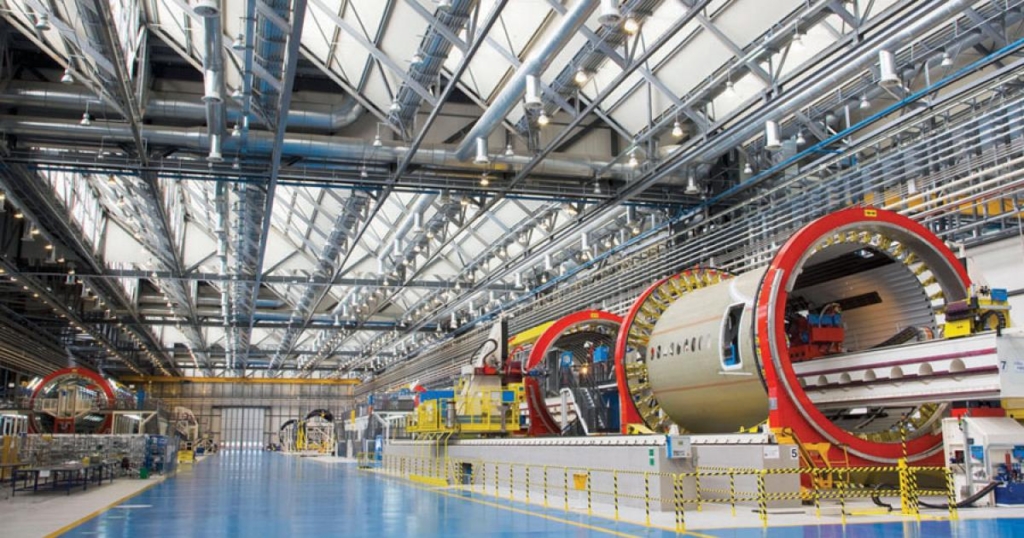
The company also builds the 787’s composite horizontal stabiliser at Foggia. Leonardo estimates that its work accounts for approximately 14% of the Dreamliner’s airframe, covering fuselage Sections 44 and 46 and the horizontal tail.
Once completed, the Italian fuselage barrels are transported to the United States for integration with sections produced elsewhere.
The United States builds the nose, pylons and aft fuselage
Although international suppliers produce much of the 787’s large composite structure, the United States remains central to the aircraft’s manufacturing system as well as its final assembly.
The fully integrated Section 41 forward fuselage, including the cockpit and nose, is manufactured in Wichita, Kansas. The section is delivered with systems including wiring, flight-deck structures, cargo doors, landing gear and the radome already installed. Engine pylons and wing leading-edge structures are also produced through the Wichita-based operation.

This work was historically undertaken by Spirit AeroSystems, but Spirit became wholly owned by Boeing again when the manufacturer completed its acquisition in December 2025.
Boeing’s US facilities also manufacture aft-body structures and numerous composite, structural and systems components. American suppliers, including Collins Aerospace, provide a substantial range of electrical power, environmental control, avionics, lighting, cargo and cabin systems for the aircraft.
South Korea supplies aft-body and wing components
South Korea also contributes several distinctive composite structures.
Korean Air’s Aerospace Division manufactures the 787’s raked wingtips, flap-support fairings, aft-body structure and aft wheel-well bulkhead at its facility in Busan. The airline has participated in the Dreamliner’s design and manufacturing programme since 2006, making it both a 787 operator and an industrial supplier.

The raked wingtips form the outer ends of the wings, while the flap-support fairings are the streamlined structures visible beneath the wing. Although smaller than a fuselage barrel or wing box, they remain important aerodynamic and structural elements.
Australia builds the movable trailing edges
Boeing Aerostructures Australia produces the 787’s movable wing trailing edges at Fishermans Bend in Melbourne.
Australia is the sole-utboard flaps, flaperons and ailerons. These surfaces control lift and roll during different phases of flight and are manufactured using an advanced composite resin-infusion process
It is one of Australia’s most significant continuing roles in a global commercial aircraft programme.
Sweden manufactures the Dreamliner’s cargo doors
Saab manufactures the 787’s large cargo doors, bulk cargo door and access doors in Sweden.
Unlike a conventional metal door supplied as a bare structure, the composite door assemblies incorporate operating systems and control equipment before delivery. Saab extended its production agreement with Boeing in 2023 after delivering more than 1,100 shipsets for the programme.
Some lower-tier parts for the Saab door assemblies ares beyond the most visible tier-one suppliers
Canada contributes structures and the auxiliary power unit
Canada’s contribution includes composite aerostructures and one of the aircraft’s most important power systems.
Boeing’s Winnipeg facility manufactures hundreds of composite parts for Boeing aircraft, including the 787’s main landing gear doors.
The aircraft’s APS5000 auxiliary power unit is supplied by Pratt & Whitney Canada. Designed exclusively for the 787, it provides electrical power when the main engines are not operating and also supports engine starting. It is the first all-electric auxiliary power unit developed for a large commercial aircraft.
This corrects a common misconception that the Dreamliner’s auxiliary power unit is supplied by Honeywell.
Is the 787’s landing gear French or British?
The landing gear demonstrates why assigning each 787 component to a single country can be misleading.
France-based Safran designed and integrates the Dreamliner’s main and nose landing gear and supplies its electric braking system. However, Safran says production activities are distributed across Canada, China, France, Mexico, the United Kingdom and the United States. Final integration has taken place at facilities in Ajax, Ontario; Everett, Washington; and Charleston, South Carolina.
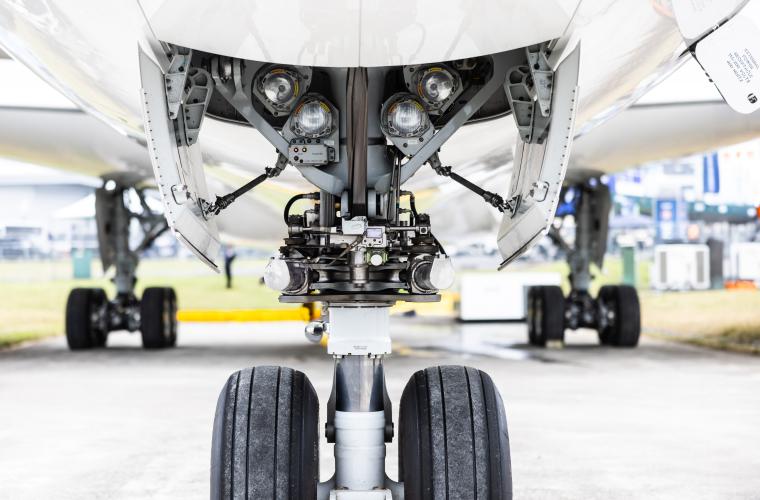
The UK has a particularly important role through Safran Landing Systems’ Gloucester operation, which designs and manufactures landing gear for the 787 and other aircraft. Safran facilities in Wolverhampton and Banbury also produce actuation systems and tubular components used on the Dreamliner.
It is therefore more accurate to describe the landing gear as a multinational Safran product than as an entirely French-built system.
Where are the Boeing 787’s engines built?
Airlines can choose between the GE Aerospace GEnx-1B and the Rolls-Royce Trent 1000, adding another international production network to each aircraft.
The GEnx is principally assembled in the United States. Major modules come together at GE Aerospace’s facility in Durham, North Carolina, before the engine moves to Peebles, Ohio, where the fan and fan case are fitted, and production testing is completed. GE has said the wider GEnx supply chain involves manufacturing sites in six countries, including programme partners IHI in Japan and Avio Aero in Italy.

The Trent 1000 is assembled and tested at Rolls-Royce facilities in Derby and Singapore. Derby remains a major production centre for the engine, while Rolls-Royce’s Seletar campus provides additional assembly, test and fan-blade manufacturing capacity.
The engine choice changes the national content of an individual Dreamliner, but it does not make either powerplant exclusively American or British. Both rely on multinational supplier networks.
How the Dreamlifter connects the 787 production network
Boeing developed the Dreamlifter specifically to make this production model possible.
Four Boeing 747-400s were converted into outsized freighters capable of carrying 787 wings, fuselage barrels and other major assemblies between supplier locations and Boeing’s US facilities. Atlas Air operates the aircraft on Boeing’s behalf.
With an enlarged upper fuselage and a tail that swings open for loading, the Dreamlifter can carry major structures across North America, Europe and Asia without requiring them to be broken into smaller assemblies.
The system allows Boeing’s partners to complete more work before shipment, but it also makes the programme dependent on tightly coordinated international logistics.
An American aircraft built by a global industry
The 787 is designed by Boeing, finally assembled in South Carolina and delivered as an American aircraft. Nevertheless, its physical production stretches across a remarkable international network.
Japan builds its wings and centre wing structure. Italy supplies large fuselage sections and the horizontal tail. South Korea manufactures aft-body and wing components, Australia produces its movable trailing edges, Sweden supplies its cargo doors, and Canada contributes composite structures and the auxiliary power unit. The UK, France, Germany, Singapore, China, Mexico, India and other countries enter the aircraft through landing gear, engines, systems and lower-tier components.
That international production model is the real answer to where the Dreamliner is built. Its final form comes together in North Charleston, but the aircraft itself is the product of an aerospace supply chain spanning several continents.
News
Air TransportEngines/propulsionManufacturingMost ReadTrending ArticlesboeingBoeing 787 DreamlinerGE AerospaceLeonardoRolls RoyceSafran
Sign up for our newsletter and get our latest content in your
inbox.
1
Behind the scenes: How Farnborough International Airshow keeps its flying display safeBehind the scenes: How Farnborough International Airshow keeps its flying…
Farnborough Internation…
2
How do pilots plan their flying displays at airshows?
How do pilots plan their flying displays at airshows?
Airshows
3
Updated: eVTOLs and next-generation aircraft to watch at Farnborough International Airshow 2026
4
Farnborough International Airshow 2026: The order rumours
Farnborough International Airshow 2026: The order rumours
Air India
