

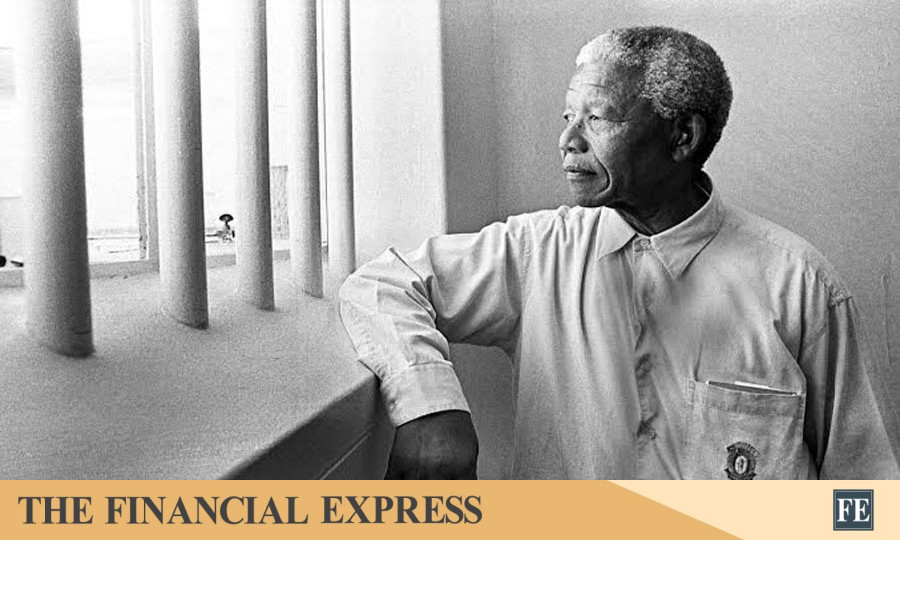
I had the privilege of visiting Robben Island in 2001, during my first trip to Cape Town. I left my luggage at the hotel and headed straight there. I felt that if work kept me too busy over the following weeks and I missed the opportunity to visit the island, it would remain one of the greatest regrets of my life.
Today, the whole world knows about the tiny cell of Robben Island where Mandela was confined for 18 years. Yet standing before it in person, contemplating that someone whose moral stature towered above the sky had been imprisoned there for years, is an experience that simply cannot be put into words. He was released from the jail in 1990.
Mandela taught us that human beings possess the strength to become greater than their sufferings. When apartheid officially came to an end in South Africa in 1994, he chose reconciliation over bitterness and confrontation with the white minority. He refused to allow the wounds of the past to define the future.
At a time when leaders in various parts of the world continue to invoke painful chapters of history in ways that divide rather than unite their nations, Mandela demonstrated that it is possible to acknowledge the past without becoming paralysed by it. In awarding him the Nobel Peace Prize, the Nobel Committee observed that, in a world scarred by violence, Mandela upheld the highest ideals of humanity. He showed that societies can break free from cycles of hatred and violence and build a future founded on peace.
Conversations with Myself is a carefully edited collection of Mandela’s personal letters, interviews, diary entries and unpublished autobiographical writings. Throughout the book, he pays heartfelt tribute to friends and fellow leaders such as Walter Sisulu and Oliver Tambo, and repeatedly reflects on the African National Congress’s philosophy of collective leadership. Even when writing about the white rulers, Mandela’s language remains remarkably courteous and respectful. The book stands as an extraordinary testament to his political foresight, statesmanship, integrity, courage, wisdom, humility, generosity and deep humanity. At a time when violence, incivility and narrow-mindedness have become disturbingly commonplace in politics and public life, the lessons from Mandela’s life feel especially relevant.
I was fortunate to see Nelson Mandela in person on two occasions. The first was at the closing ceremony of the International AIDS Conference in 2004. As he walked onto the stage at Bangkok’s Impact Arena, nearly 20,000 delegates offered a prolonged standing ovation. The applause seemed endless. The second time I saw him was in Cape Town. I went there to attend a week-long conference marking the centenary of the Rhodes Scholarship at the University of Oxford. Mandela attended a gala dinner as the guest of honour. The audience was completely absorbed by every word he uttered.
Mandela earned the respect of South Africans of every race through the example of his own life and leadership. When post-apartheid South Africa reached the Rugby World Cup final—a sport that until then had largely been regarded as the preserve of white South Africans—he appeared on the field wearing the Springboks jersey. In doing so, he won the hearts of many white South Africans. That is what true leadership looks like: the ability to unite a deeply divided nation at a moment when division seems insurmountable. My South African friends who knew him have told me that when people saw Mandela forgive those who had jailed him for twenty-seven years, they too became more forgiving in their own lives.
Even after stepping down from the presidency, Mandela continued to serve his country through the Mandela Foundation, working to advance education and healthcare. I still remember an AIDS awareness poster bearing his photograph with the simple yet powerful message: “Good leaders lead.”
After Mandela retired, South Africa’s political leadership failed disastrously in responding to the AIDS epidemic. At that critical moment in the nation’s history, Mandela once again stepped forward. He publicly disclosed that one of his own sons had died of AIDS. His announcement played a pivotal role in challenging the stigma surrounding the disease and encouraging people to speak openly about it. In doing so, he reminded the world that the responsibility of a leader is to lead—not to create confusion or deny reality.
Above all, Nelson Mandela was a political leader, and history will undoubtedly scrutinise and debate his political decisions. Yet the example he set through his lifelong commitment to peace and tolerance remains unparalleled. At a time when people across the world are increasingly being confined within narrow identities, Mandela reminded us that diversity is humanity’s greatest strength. It is no coincidence that South Africa’s Constitution guarantees equal rights to all people regardless of race, religion, ethnicity, language or gender.
In one of his letters, Nelson Mandela wrote:”The ideals in which we believe, our dearest dreams and our deepest aspirations, may not be realized within our own lifetime. But that is of little consequence. If we fulfil our responsibilities in our own time and continue working to meet the hopes and expectations of our people, that in itself is an extraordinary experience and a remarkable achievement.”
In recognition of Mandela’s enduring legacy, the United Nations General Assembly unanimously proclaimed 18 July—his birthday—as Nelson Mandela International Day in 2009. The day calls upon individuals, communities and organizations across the world to reflect on Mandela’s values and to translate those values into meaningful action for positive change.
Nelson Mandela Day encourages people to devote 67 minutes to public service, symbolically honouring Mandela’s 67 years of service to humanity. One might volunteer for a community initiative, donate blood, plant a tree, visit someone who is ill, read books to children, or simply perform any act of kindness that improves the lives of others. The possibilities are endless; the principle remains the same- every individual has the power to make a difference.
So, on this year’s Nelson Mandela Day, what will you do?
Laila Khodkar is an international development worker. She is the first Rhodes Scholar in Bangladesh. laila.khondkar@gmail.com
