

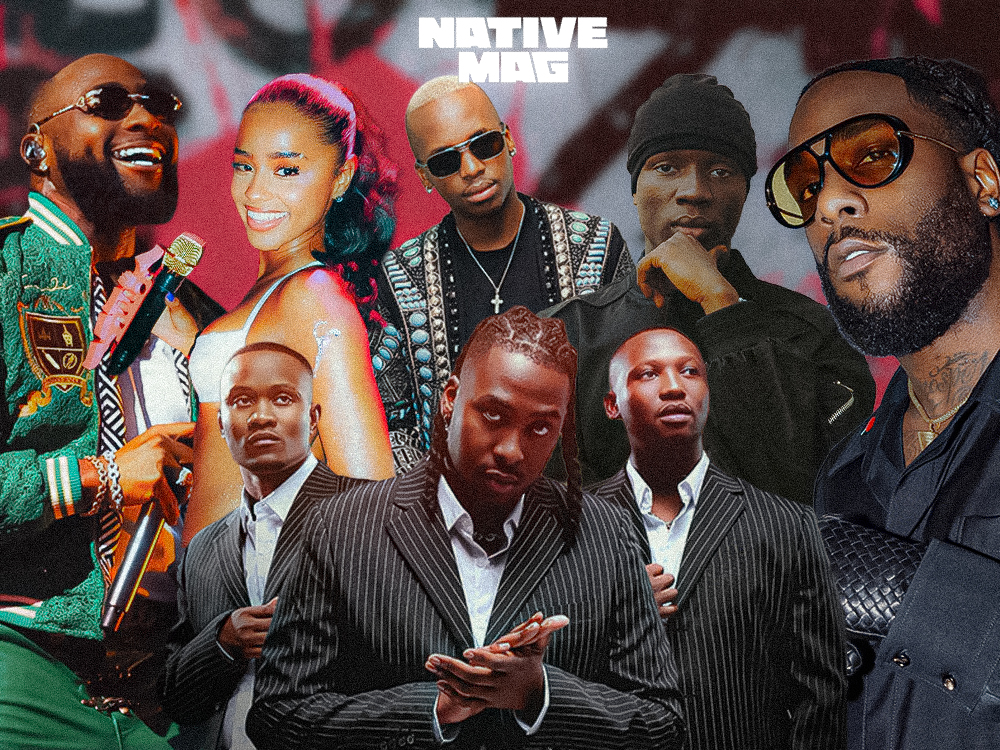
For decades, the Nigerian and South African music scenes have enjoyed a creative bonanza despite the tensions between their countries. From “Coolest Kid in Africa” and “Soweto Baby” to the more recent “Isaka,” the exchange has become almost instinctive. Last year, Ciza, Thukuthela and JAZZWRLD brought Tems and Omah Lay onto the remix of “Isaka,” sending a South African 3-Step record into Nigerian clubs. On “I Know Who I Be,”from his latest album, ‘Oriade, Davido was joined by Lesotho-born producer JAZZWRLD and South African producer GL_Ceejay. Similarly, Nigerian virtuoso Firstklaz has continued that historic partnership with “Tsammani,” another collaboration with JAZZWRLD.
In recent weeks, however, the relationship between the two countries has reached another period of tension. Amid renewed xenophobic violence and reported attacks on Nigerians and other African nationals in South Africa, Chidimma Adetshina, the Nigerian-South African beauty pageant winner, isfightingdeportation in a Cape Town court. Nigerian senator Natasha Akpoti-Uduaghan has called for reciprocal treatment of South Africans. In music, Tyla’s Lagos date disappeared from her 2026 world A-POP tour after calls for a boycott, while Ayra Starr’sperformancesin South Africa became entangledin visa complications involving members of her team.
The incidents are separate, but together they reveal something new. The old arguments about immigration, belonging and xenophobia have begun to enter the one territory where Nigerians and South Africans have usually managed to meet without much difficulty: pop culture. CanNigerians still welcome South African artists to their country when Nigerians are being attacked in South Africa? Should musicians be made to answer for the actions of their compatriots? And if the anger becomes strong enough, can a musical relationship built over decades survive it?
So far, it has.
That is because Nigeria and South Africa have created something in music that neither has managed quite so easily in politics. Their artists have borrowed from one another, their audiences have grown accustomed to one another, and their industries have become commercially entangled. What began partly as political solidarity became collaboration, then influence, and eventually something closer to interdependence.
Now, xenophobia is testing how much that history is worth. The intensity of the present anger is partly explained by its proximity to the music industry itself. Earlier outbreaks of xenophobic violence—including a video in which the leader of the anti-migration group Operation Dudula called for non-South Africans to leave public hospitals, and the controversy that followed when news of Adetshina first broke—produced boycotts and diplomatic quarrels. But the latest dispute has begun to reach the cultural spaces where the two countries have long felt most comfortable with each other. On social media, the argument is no longer simply about individual attacks. It has become a question of whether cultural exchange itself should continue.
Tyla’s missing Lagos date became the clearest symbol. A concert is ordinarily a simple transaction: an artist arrives, an audience buys tickets and, for a few hours, the politics outside disappears. But the boycott calls made the concert political. The question was no longer whether Nigerians liked Tyla’s music. It was whether welcoming a South African star amounted to accepting what Nigerians believed was happening to their compatriots in Tyla’s home country.
That distinction matters. A South African musician can be an individual artist and, at the same time, arrive carrying the nationality of a country whose treatment of Nigerians has become atry becomes harder to maintain when nationality is the thing that travels with the artist
Yet this relationship was never built on neutrality. It began, in part, in politics. During apartheid, Nigeria’s relationship with South Africa was shaped by opposition to the white-minority government and solidarity with those fighting it. Music became one of the places where that solidarity could be heard. In 1978, Sonny Okosun released “Fire in Soweto,” turning the popular uprising into a song that travelled beyond South Africa. Soweto was no longer simply a place in a distant country. It had become a symbol of a struggle that many Nigerians understood as their own.
The Nigerian state backed that solidarity beyond speeches, supporting South African exiles, offering scholarships and assisting people whose own government had restricted their movement. Nigeria and South Africa therefore entered the post-apartheid era carrying a history that was already unusually intimate.
When apartheid ended, the familiarity did not. It simply found new modes for expression.For Nigerians who came of age in the early 2000s, South Africa arrived through television before it arrived through the airport. DStv brought channels such as MTV Base and Channel O into Nigerian homes, making the continent’s music feel like one long neighbourhood. Nigerian audiences encountered South African House and Kwaito; South African audiences watched Nigerian Pop become increasingly difficult to ignore. There’s also a case to be made for movies as we both exchanged characters as shows like ‘My Flatmates,’ ‘The Johnsons‘ and most memorably MTV’s ‘Shuga.’
No one had to announce a cultural exchange. Children simply grew up hearing the same songs, watching the same videos and learning the names of artists from countries they might never have visited. By the time Nigerian and South African musicians began collaborating with the frequency they do now, much of the cultural groundwork had already been laid by the audience.
The music business followed. Labels, distributors and promoters began treating Nigeria and South Africa not as isolated territories but as two of the continent’s most important music markets. For Olusola Adenusi, Distribution Manager at Mavin Records, that commercial relationship has become too important for politics to simply switch off.
“At the end of the day, despite the global expansion of Afropop, we still need each other’s territory,” Adenusi says.“Nigeria, South Africa, and Kenya are some of the leading countries on the continent when it comes to music consumption.As an artist, you can’t say because of politics, you don’t want to push your music over there. It is ultimately to your own detriment.”
It sounds cynical in the face of of xenophobia, but the music business is rarely sentimental. A record needs an audience. A touring artist needs a market. A label wants its songs heard. Politics can make a border hostile without making the audience on the other side disappear. And the exchange has never been one-way. Nigerian Pop did not simply arrive in South Africa as a finished product, nor did South African music remain something Nigerians consumed through television. The sounds began to change each other.The clearest example is Amapiano. Its arresting log drums and airy rhythms were absorbed by Nigerian producers and reshaped around Afrobeats’ melodies, vocal styles and songwriting. The sound became so deeply embedded in Nigerian Pop that arguments over whether Nigerians were borrowing, adapting or appropriating Amapiano.
But the argument itself revealed how far the sound had travelled. A South African genre had become part of Nigeria’s musical vocabulary.The exchange had already been happening in individual records. Nigerian superstar, Burna Boy, appeared on a remix of Master KG’s “Jerusalema,” helping to bring a Nigerian presence to a song whose roots remained unmistakably South African. AKA, DA L.E.S and JR joined Burna Boy on “All Eyes on Me.” Wizkid worked with DJ Maphorisa on “Soweto Baby.” Davido teamed up with Nasty C on “Coolest Kid in Africa.”
Taken together, these were more than meetings between artists from two countries. They were signs of a musical language becoming shared.By the time “Isaka” was remixed with Tems and Omah Lay, the traffic had become almost circular: a South African 3-Step record could travel north, acquire Nigerian voices and return to the continent with a larger audience. For Nigerian producer Timi “Timmy” Adetiloye, the reason is almost instinctive. “Personally, the relationship has stood strong because, foremost, the African element, but also, both countries share a similar energy,” he tellsNATIVE Mag. “One prominent thing between both countries is that they both love to dance. There’s a resonance in both sounds, and the history in collaborations as well has also strengthened that bond.”
There is perhaps a simpler way of putting it. The two countries have spent so long listening to each other that influence has become difficult to trace back to itsrian accent and return as something neither side can outrightly claim
That is why a musical rupture would be more than another cancelled show or angry exchange online. Nigeria and South Africa are no longer merely borrowing from one another. They have built shared audiences, commercial routes and musical vocabularies that neither side can easily replace.
So what, exactly, would either country lose?
The answer, according to music journalist Tomide Marv is both.“We both get great value exchange out of each other, creativity-wise,” Marv tellsNATIVE Mag. He is less romantic about what keeps the relationship alive. “The creative/music industry loves money I don’t see them letting that fuck up the business.”
There is a blunt truth in that. The relationship has survived partly because it is useful. Nigerian audiences consume South African sounds. South African artists find audiences and a new lease of life in Nigeria. Producers collaborate across borders. Labels distribute music across both territories. The business has developed its own reasons to keep moving, even when politics gives it reasons to stop.
But usefulness is not reconciliation. Marv does not believe music can repair the deeper wounds between Nigerians and South Africans. “Music seems like it has that power, but no,” he explains toNATIVE Mag. “There must be dialogue that goes beyond beats and drums and rhythms and melodies.” Governments, he argues, have to create a path for a conversation that may take years to repair what has been damaged.
Perhaps this is where the music relationship becomes most revealing. It has not erased xenophobia. It has not made Nigerians safer in South Africa or settled the arguments over immigration and belonging. What it has done is keep the two countries in contact when politics has repeatedly given them reasons to retreat from one another.
The artists keep collaborating. The audiences keep listening. The markets keep meeting. Politics may give Nigeria and South Africa reasons to turn away from each other. Music, stubbornly, keeps giving them reasons to return.


