


Press Release
3 September 2026
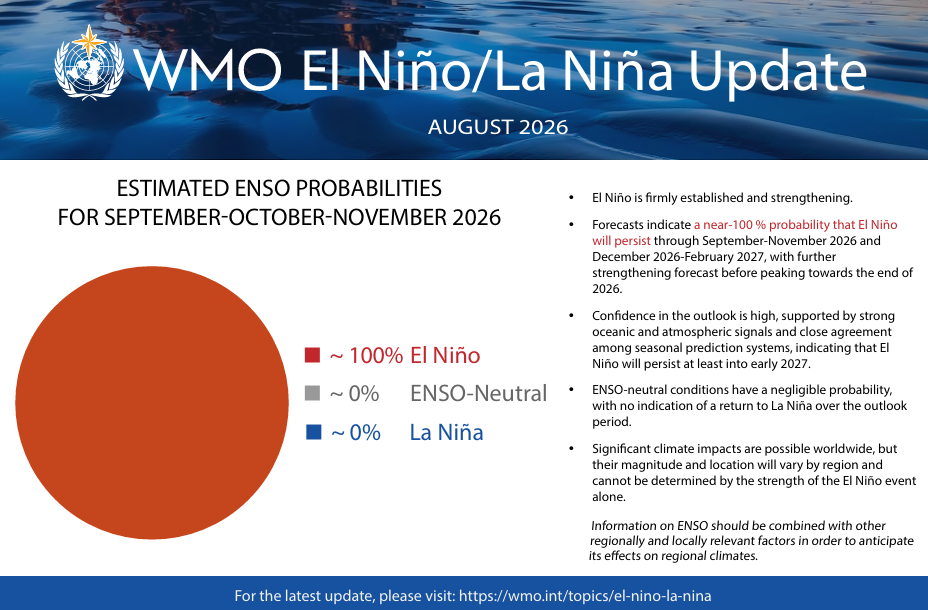
Geneva, Switzerland (WMO) – El Niño is firmly established and will intensify into a very strong event in the coming months, with big impacts on rainfall and temperature patterns and associated risks of floods, drought and extreme heat, according to a new update from the World Meteorological Organization (WMO).
- El Niño is firmly established and is expected to strengthen further
- WMO Forecasts show near 100% likelihood that it will persist through February 2027
- Exceptionally warm tropical Pacific Ocean conditions support further intensification
- A very strong El Niño can significantly shift rainfall and temperature patterns worldwide and fuel extreme weather
- WMO and National Meteorological and Hydrological Services step up preparedness and early-warning efforts for an exceptional event

Forecasts from WMO’s Global Producing Centres indicate an “exceptionally high likelihood of nearly 100%” that El Niño will persist through to February 2027. This is the first time that a WMO El Niño/La Niña Update has been so unequivocal, reflecting the strong agreement within WMO’s extensive network.
Fueled by exceptionally warm ocean conditions across the tropical Pacific, El Niño is expected to strengthen further during the coming months to a very strong intensity before peaking towards the end of this year, with climate impacts continuing well into 2027.
“El Niño is being supersized before our eyes. The science leaves no room for doubt: the planet is in uncharted waters, and those waters are heating up. Sea surface temperatures are rising, temperatures keep climbing, and the world is in the danger zone of extreme weather. The race now is between rising risks and our commitment to take climate action and protect people. We must win that race,” said UN Secretary-General António Guterres
“El Niño in Spanish means boy child – but it has the potential to deliver a massive blow to communities and economies across the world. We are already seeing disruption and devastation from droughts and floods and we expect these impacts to increase as El Niño intensifies,” said WMO Secretary-General Celeste Saulo.
“This exceptional El Niño demands exceptional preparation and response. Never before in the 50-year history of the World Meteorological Organization have we launched such a major mobilization with National Meteorological and Hydrological Services who are on the frontline of delivering the forecasts and services to save lives and livelihoods,” she said.
“WMO is committed to working closely with partners across the United Nations and humanitarian system to provide the climate intelligence and insights needed to support disaster management and climate-sensitive sectors like agriculture, health, energy and water re
WMO El Niño/La Niña Updates are the world’s most authoritativeasonal forecasts are based on a consensus of models from WMO Global Producing Centres, experts from National Meteorological and Hydrological Services and climate prediction centres around the world
Exceptional ocean heat in the tropical Pacific
Sea surface temperatures across the central-eastern equatorial Pacific, the region at the heart of El Niño, are already well above average – one of the tell-tale signs of El Niño – and are continuing to rise.
The widely used Niño 3.4 index, which measures sea surface temperature anomalies in central-eastern equatorial Pacific has strengthened markedly from an average +1.5 °C above normal during May-July 2026 and +2.0 °C above normal in July. Weekly values subsequently increased further between late July and mid-August, ranging from approximately +2.2 °C to +2.6 °C above average, indicating continued intensification.
Even more exceptional warmth is present below the ocean surface. In some areas, subsurface ocean temperatures were more than 8°C above average during July and early August.
Together, the surface and subsurface ocean conditions provide strong support for continued El Niño conditions and the potential for further strengthening during the coming months, the Update says.
Confidence in the outlook is high. Strong and mutually reinforcing oceanic and atmospheric signals, together with close agreement among seasonal prediction systems indicate that El Niño will persist at least into early 2027.
Very Strong El Niño does not mean the same impacts everywhere
El Niño and La Niña are among the most powerful naturally occurring influences on the global climate system. A very strong event increases the likelihood of major changes in rainfall, temperatures and atmospheric circulation across many regions of the world.
However, the strength of an El Niño event alone does not determine how severe its impacts will be in any individual country or region.
Its effects vary according to location and season and can be modified by other climate drivers, including conditions in the Indian and Atlantic Oceans.
WMO has therefore issued a complementary Global Seasonal Climate Update, which brings together information about El Niño and other major climate drivers, enabling a more refined picture of expected conditions.
For September–November 2026, WMO multi-model forecasts indicate an increased likelihood of above-normal temperatures across almost all land areas, alongside rainfall patterns showing a pronounced and classic atmospheric response to the strong Pacific El Niño.
A positive phase of the Indian Ocean Dipole (IOD) is also expected to develop, reaching a September-October-November 2026 seasonal mean value of 0.9°C. Meanwhile, the equatorial Atlantic basin is forecast to remain generally warm, with SSTs in both the North and South Tropical Atlantic staying above normal. These conditions may reinforce, weaken or alter typical El Niño impacts in different regions.
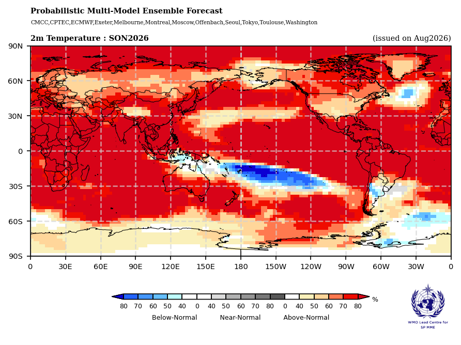
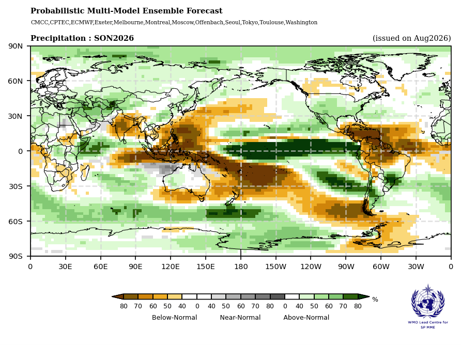
Probabilistic forecasts of surface air temperature and rainfall for the season September-November 2026. The tercile category with the highest forecast probability is indicated by shaded areas. The most likely category for below-normal, above-normal, and near-normal is depicted in blue, red, and grey shadings respectively for temperature, and yellow, green and grey shadings respectively for rainfall. White areas indicate equal chances for all categories in both cases. The baseline period is 1993–2009. (Source: The WMO Lead Centre for Seasonal Prediction Multi-Model Ensemble)
More detailed and locally applicable information is provided through WMO Regional Climate Centres, WMO Regional Climate Outlook Forums and National Meteorological and Hydrological Services.
Turning forecasts into early action
El Niño and La Niña are opposite phases of the El Niño–Southern Oscillation (ENSO); one of the most powerful naturally occurring climate patterns on Earth.
El Niño is characterized by a warming of ocean surface temperatures in the central and eastern Equatorial Pacific. It typically occurs every two to seven years and lasts around nine to twelve months.
El Niño generally begins developing between March and June and reaches its peak intensity between November and February. Its impact on global temperatures can extend beyond the period of peak ocean warming and be most pronounced in the year after development.
Because El Niño can reshape weather and climate patterns thousands of kilometres away from the tropical Pacific, reliable forecasts provide governments, humanitarian agencies, businesses and communities with valuable time to prepare.
WMO Members and partners will therefore continue to closely monitor the evolution of the event and regularly update forecasts of its likely regional impacts.
National Meteorological and Hydrological Services remain the authoritativen.
El Niño is a natural climate phenomenon and is not caused by climate change
Notes to Editors
The WMO El Niño/La Niña Update is prepared through a collaborative effort between the WMO and Center for Climate Systems Research (CCSR) / International Research Institute for Climate and Society (IRI) Columbia Climate School, USA, and is based on contributions from experts worldwide, inter alia, of the following institutions: Australian Bureau of Meteorology (BOM), Centro Internacional para la Investigación del Fenómeno El Niño (CIIFEN), China Meteorological Administration (CMA), Climate Prediction Centre (CPC) and Pacific ENSO Applications Climate (PEAC) Services of the National Oceanic and Atmospheric Administration (NOAA) of the United States of America (USA), European Centre for Medium Range Weather Forecasts (ECMWF), Météo-France, India Meteorological Department (IMD), Indian Institute of Tropical Meteorology (IITM), International Monsoons Project Office (IMPO), Japan Meteorological Agency (JMA), Korea Meteorological Administration (KMA), Met Office of the United Kingdom, Meteorological Service Singapore (MSS), WMO Global Producing Centres of Seasonal Prediction (GPCs-SP) including the Lead Centre for Seasonal Prediction Multi-Model Ensemble (LC-SPMME).
Since the 1980s, the dominant approach to measuring or identifying El Niño has been the use of the Oceanic Niño Index wherein scientists calculate the Sea Surface Temperature Anomaly in a specific region of the Pacific called the Niño 3.4 region.
When computed over a three-month average, this becomes the Oceanic Niño Index (ONI). In recent years and with global warming, a newer metric of measurement called the Relative Oceanic Niño Index (RONI) has gained ground. This approach measures relative warming, not just absolute warming, helping scientists assess whether a warming event is ENSO-driven or mostly due to global ocean warming.
The World Meteorological Organization is the United Nations System’s authoritative voice on Weather, Climate and Water.
For further information, please contact:
- Clare NullisWMO media officercnullis@wmo.int+41 79 709 13 97
- Global Communication and Engagement Media Contactmedia@wmo.int

