

Overture
- To find out what “Europe” means to people today, ECFR commissioned almost 6,000 interviews in six European countries and qualitative desk research across 15 more.
- The interviews reveal that most people have strong opinions about Europe and its future; the complementary research found that geopolitical chaos and culture wars are helping the EU become more politicised in domestic debates.
- How people feel about Europe may thus affect how they vote in the potentially seismic domestic elections to come, in many of which the far right leads in the polls.
- The interviews also found many people want a stronger, more independent and more united Europe. But relatively few can picture a credible route from today’s disruptions to that destination.
- This imagination gap is most prevalent among a pivotal constituency we call “the uncertain”. Pro-European leaders need to fill it, lest people become more receptive to politics that reinterpret the past as the future.
- These leaders can do so by harnessing the power of “future nostalgia”, or a longing for a time when a better future seemed within reach.
Broken records
For decades, Europe had quite a successful record. Its countries grew accustomed to living under America’s protection, trading freely with one another, and enjoying peace and prosperity at home. Borders opened and the EU expanded. Europe came to think of itself as one of the world’s economic and political centres of gravity—or even a model for others to follow.
But then, one by one, the cosy assumptions on which Europe had built its post-cold-war existence began to fall apart. It was time for Europe to change its tune. As European Commission president Ursula von der Leyen put it, there was “no time or room for nostalgia… this must be Europe’s independence moment”. Leaders across the continent offered variations on the same theme: Europe must become stronger, more united and more independent.
As the months passed, parts of the public saw Europe moving in that direction. But many others concluded different things from the same events. For some, the disruptions had exposed a system that had long been dysfunctional and captured by elites. Others hesitated, realising that the danger could finally stir Europe from its slumber but that it could also expose divisions impossible to overcome. And then there were some like the Frenchman quoted at the start of this section who just did not care: Europe was and always had been a background hum that barely registered in their lives.
This paper shows that people with views like his are in a minority. “Europe” may not be the most important issue in people’s lives, but it is something a lot of them care about. How people feel about Europe may thus affect how they vote at home and contribute to how much say the far right has in shaping the future of the continent.
The paper draws on 5,834 AI-moderated interviews with European citizens conducted in May and June 2026 in Britain, France, Germany, Italy, the Netherlands and Poland. These capture how ordinary people, in their own words, imagine Europe’s future. They also provide (after weighting) a nationally representative picture of how people’s views are distributed. The interviews are complemented by comparative desk research on public and political debates in 15 EU member states. This examined how Europe and the EU are discussed across national political and media environments.
The main finding of the research is that many Europeans have an “imagination gap”. A lot of the people interviewed—especially among a substantial group we call the “uncertain”—want a stronger, more integrated and more independent Europe. But they often struggle to picture a credible route from today’s disruptions to that destination. The complementary research finds this gap exists at a time when Europe and the EU are becoming more salient in the public debate, and more politicised.
The people we spoke to are hardly alone in their pessimism. ECFR’s 2025 polling revealed Europeans to be notably gloomy about the future of their countries and the world, and that Americans and Turks shared similar sentiments. But pessimism comes with a unique political risk in Europe. Americans who lose faith in the future cannot realistically demand that the US be dismantled. Yet Europeans who lose confidence in the EU can plausibly ask for “less Europe” or even their country’s exit. And European integration has always depended on a future-facing promise: the idea of an “ever closer union” asks people to believe in both what Europe is and what it might become.
So, the imagination gap could help explain why nostalgic politics has become attractive to some voters in Europe. When people struggle to imagine a believable tomorrow, they become more receptive to visions that reinterpret the past as the future. But pro-European leaders should aim to harness a different kind of nostalgia—a “future nostalgia”, to borrow Dua Lipa’s 2020 album title, or a longing for the sense that a better future was within reach. They may need to hurry. As Europe braces for national elections in several influential countries, some with the far right leading in the polls, pro-Europeans need to help ensure a recognisable Europe exists to defend in the years ahead.
Europe’s alarm bells
Each interview begins with an icebreaker question: “Let’s imagine you have a friend who fell asleep five years ago and has just woken up. This friend asks you: ‘How is Europe doing at the moment?’ How would you describe Europe today—what would you tell them?” In their answers, by far the largest group of respondents (on average 68% across the six countries studied) talks about a general deterioration or loss of normality. Only 12% see opportunity in the crises confronting the continent and frame their responses in terms of Europe’s awakening or renewal.

Respondents speak of Europe’s awakening most often in Poland (21%). This is the most recent one of the six countries studied to join the EU and is closest to the Ukrainian war zone. According to one Pole, born in the 1980s, Europe is doing reasonably well. It’s trying to strengthen itself and be more independent from the USA.Read the extended quote from A European from Poland, born in the 1980s Or, to quote an older respondent in Germany, where just 13% of people raise these themes, Crises make you stronger, and I think that applies to Europe as well. Investment in defence is increasing again. The crises have revealed the weak points, and we can start working on them.Read the extended quote from A European from Germany, born in the 1960s Such voices of encouragement are particularly sparse in France, where a mere 5% of respondents describe today’s Europe in terms of awakening or renewal. This is despite a decade of calls for “strategic autonomy” from President Emmanuel Macron.
When it comes to naming Europe’s challenges, people most often talk about war and security, followed by economic pressures. But almost three-quarters of the people interviewed say Europe is coping badly with its greatest challenges. For this, they blame national governments twice as often as European institutions and EU leaders. According to a French respondent, born in the 1960s, Leaders of the countries do what suits their own country; they don’t see unity and don’t want it.Read the extended quote from A European from France, born in the 1960s
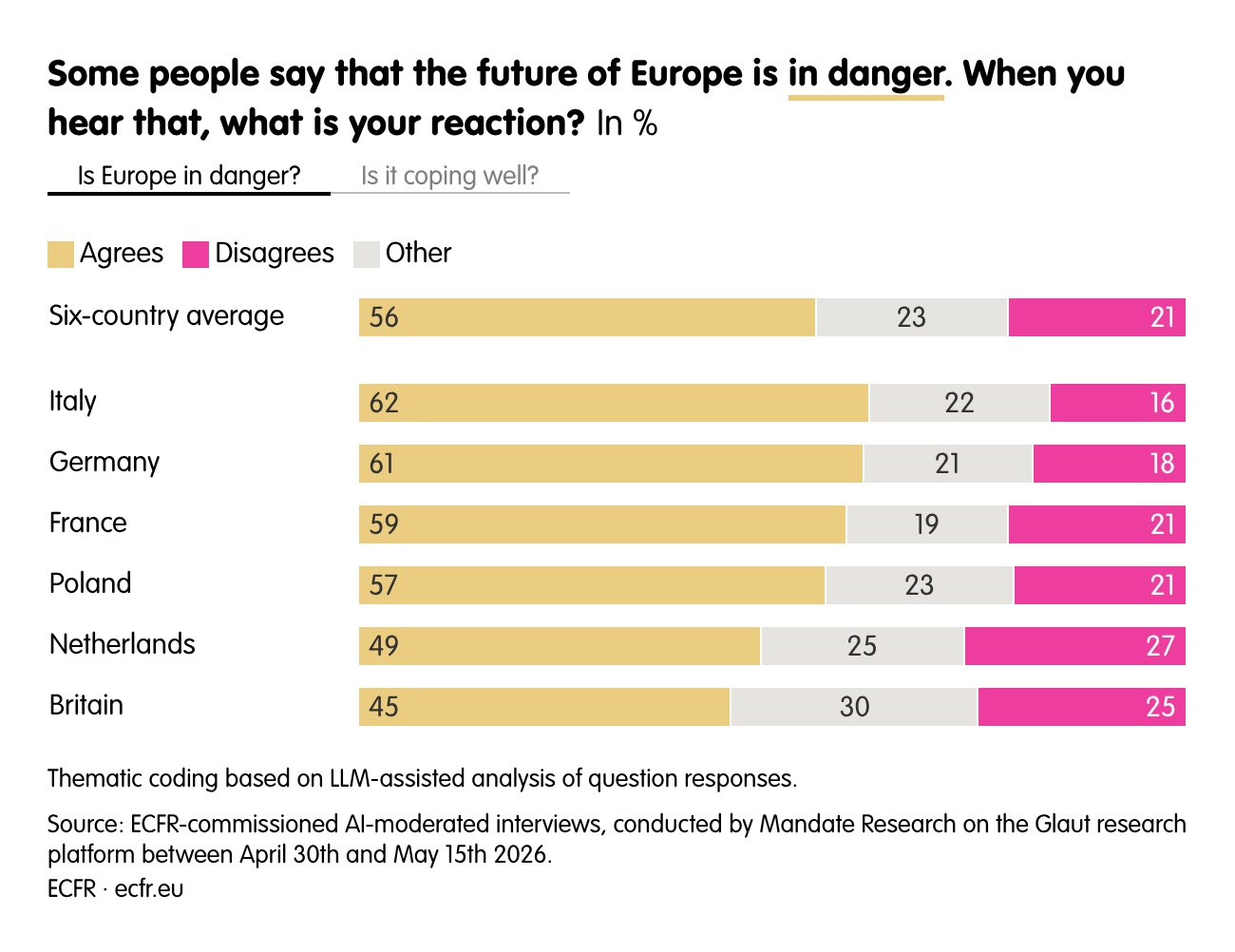
Turning to where things are heading, the AI asks: “Some people say that Europe’s future is in danger. How do you react when you hear that?” In response to this, on average 56% agree, against only 21% who disagree.
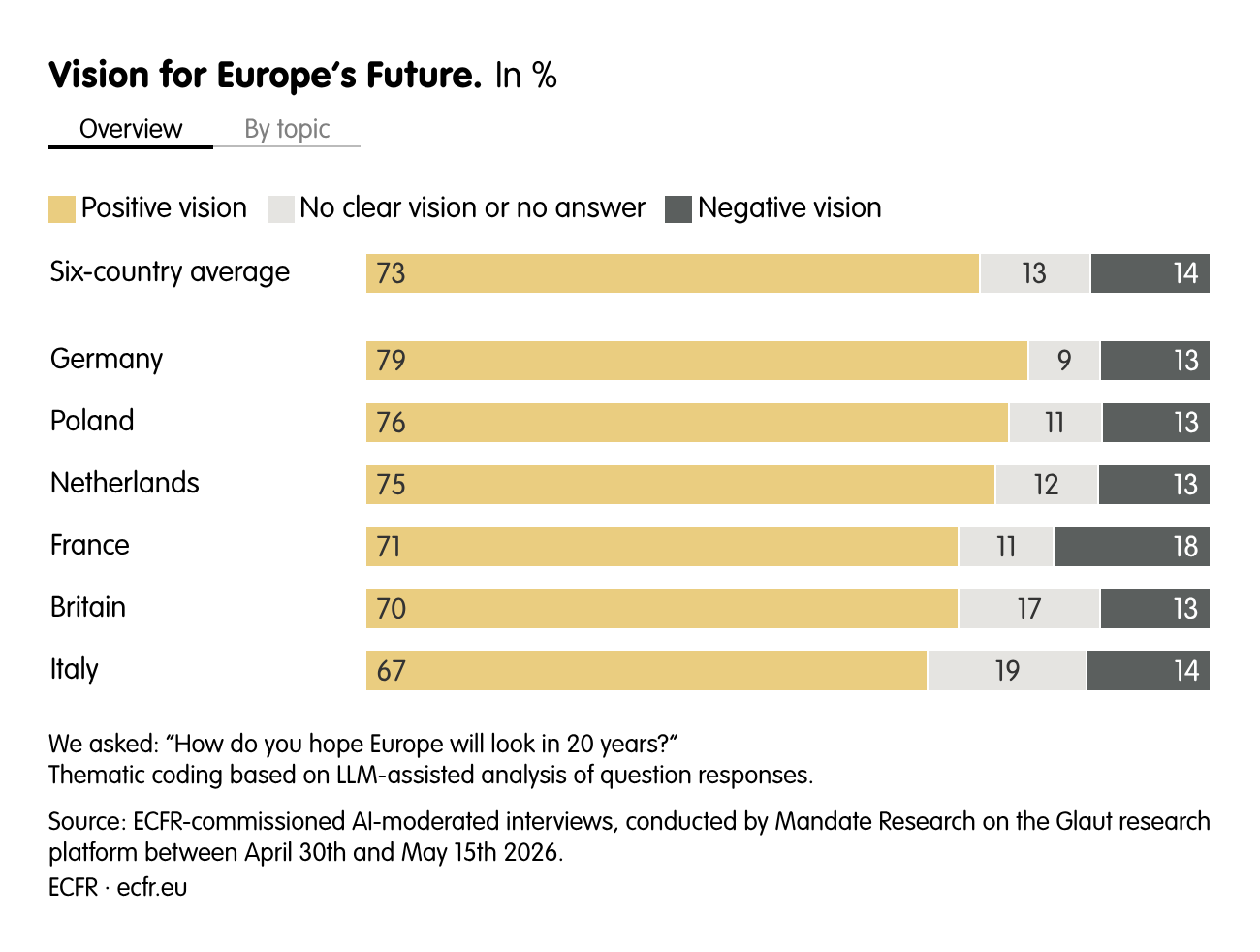
Still, many of the people interviewed identify strongly with Europe and want it to flourish. When asked what they would like Europe to look like in 20 years, three-quarters describe a positive European vision. They most often talk about unity and political integration, peace and security, and prosperity and well-being. Only around 13% hope for “less Europe” or for the EU’s dissolution.
But big dreams about Europe often come with big doubts. As one German, born in the 1990s, says: “I’m regularly relieved that I live in Europe. It’s not perfect and some things are going in the wrong direction at the moment, but no region in the world is safer, freer and more democratic.” He sees “climate catastrophe and attacks on democracy from the far right” as the greatest challenges facing Europe today—but does not think Europe is handling them very well. Asked about the reasons for this, he replies: “Elections focus too much on the here and now and not enough on the future.” Thinking about Europe in 20 years, he would like it to be “free, democratic, sustainable, less indebted, politically further to the left [and] peaceful”. But, on whether this is likely to happen, his response is a brusque: No.Read the extended quote from A European from Germany, born in the 1990s
Across the countries covered by our interviews, many conversations followed a similar pattern. People appreciate Europe, but they recognise the challenges it faces and express little faith in its collective capacity to deal with them. Even when respondents have big ambitions for Europe, they often talk about them as mere aspirations that are unlikely to become reality.
So, it may no longer be enough to distinguish only between pro-European and Eurosceptic voters. Another important divide is whether people believe European leaders (EU and national alike) can turn their hopes into reality.
Four tunes
Most of the people interviewed express strong opinions about Europe’s future. And they tend to imagine that future in one of four ways.
The positive hear an anthem of renewal: today’s disruptions are finally forcing Europe to become stronger and more united. The negative hear a ballad of decline, with each new crisis confirming the continent’s best days are behind it. For the uncertain, the melody of a better Europe is recognisable, but the song is not finished—and they are not convinced it ever will be. Very few people belong to the disconnected, for whom Europe is just a background hum coming from too far away to command much attention.
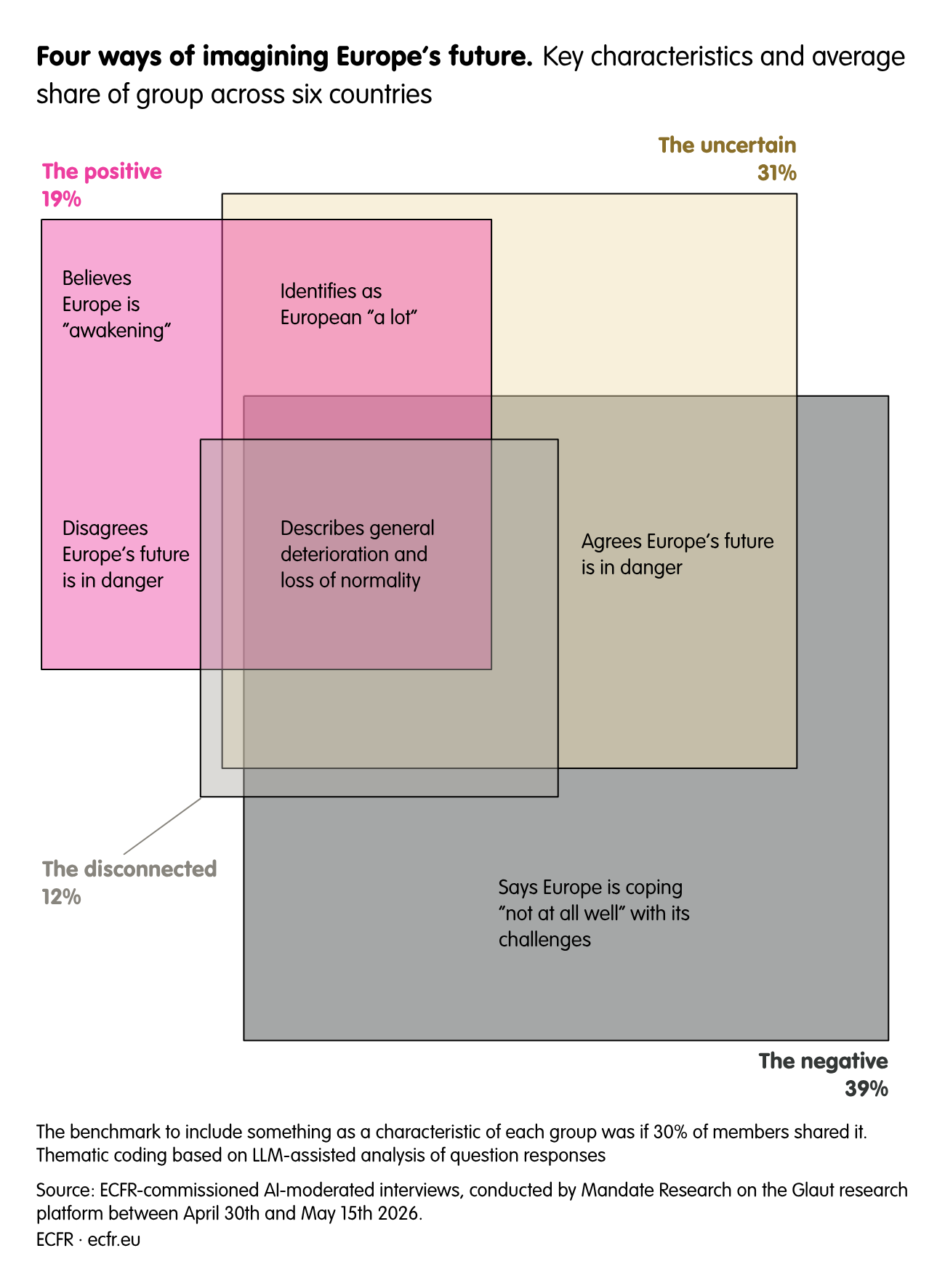
The tunes vary by country. But the four basic themes recur across borders, genders and generations.
The positive
Europe’s future is not a scary place for the positives. Fundamentally, the EU is still a good story,Read the extended quote from A European from Germany, born in the 1970s says one German, born in the 1970s, who votes for the centre-left Greens. It still has a bright future ahead of it,Read the extended quote from A European from France, born in the 2000s asserts a supporter of the leftist France Unbowed (LFI), who was born in the 2000s. Just under 20% of the people interviewed belong to this group of optimists.
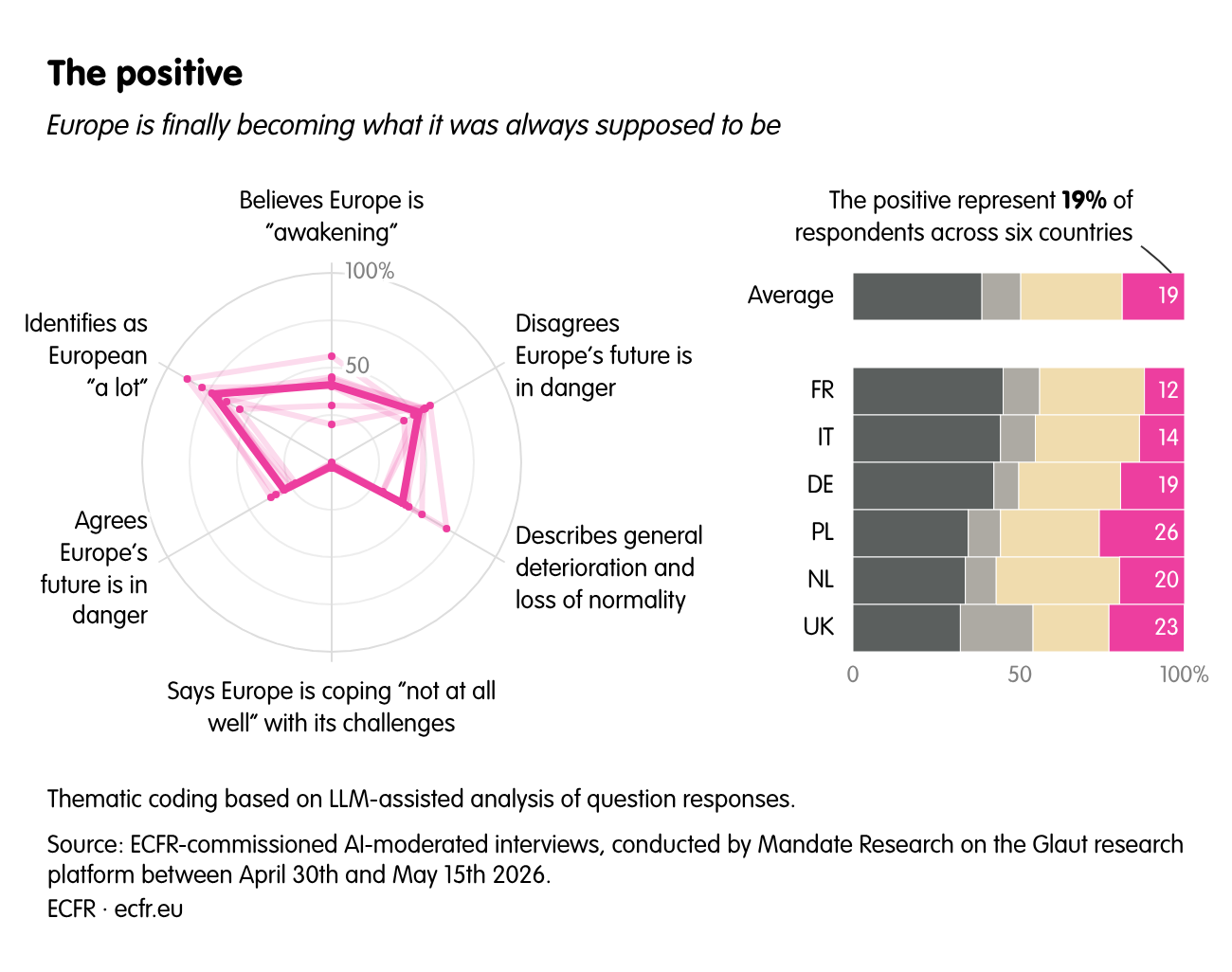
The present: The positive identify strongly as European, and two-fifths of them describe the EU’s situation today in terms of awakening. They are well represented in the electorates of EU-enthusiastic parties like the centrist Civic Coalition in Poland, Liberal Democrats in Britain and D66 in the Netherlands, as well as left-leaning EU-fans like the German Greens and the UK’s Labour Party.
Many of this group see the disruptions of the present as giving the EU the shock it perhaps always needed for its leaders to push for greater European integration and autonomy. One Dutch D66 voter, born in the 1980s, describes this as “a sense of urgency, the realisation that we must stand up for ourselves”. He stresses a shared awareness from the populationRead the extended quote from A European from the Netherlands, born in the 1980s as contributing most to this.
The future:This is not to say the positive think it will be easy. They recognise that to overcome Europe’s problems, political will and institutional reform will be necessary. Many of this group also think the EU will have to address the national vetoes that hinder collective action.
It is common among the positive to worry about the rise of the far right, but they still tend to believe change is possible precisely because the alternative has become so visible: a fragmented Europe, dependent on others and unable to defend itself or its interests. “Five years ago, I think there was more of an illusion of stability,” says one Italian, born in the 1990s, but today many things are more explicit … so I’d say [Europe has become] more unstable but more honest compared to before.Read the extended quote from A European from Italy, born in the 1990s
Still, most of the positive disagree with the idea that Europe’s future is in danger. It’s a very serious crisis, but I think that with wise policymaking [the danger] can be avoided,Read the extended quote from A European from Poland, born in 1990s says a Civic Coalition voter in Poland. Members of this group want Europe to show leadership and assertiveness internationally. And in 20 years, most of them hope to see a more united and better integrated Europe. They also tend to believe such a future is achievable.
In the world of the positive, the EU does not need to take a fundamentally different direction; rather, it needs to become what it was always meant to be. “We have it in our hands,” says a Dutch D66 voter, born in the 1980s, who has doubts about the pace, not the direction.Read the extended quote from A European from the Netherlands, born in the 1980s
The negative
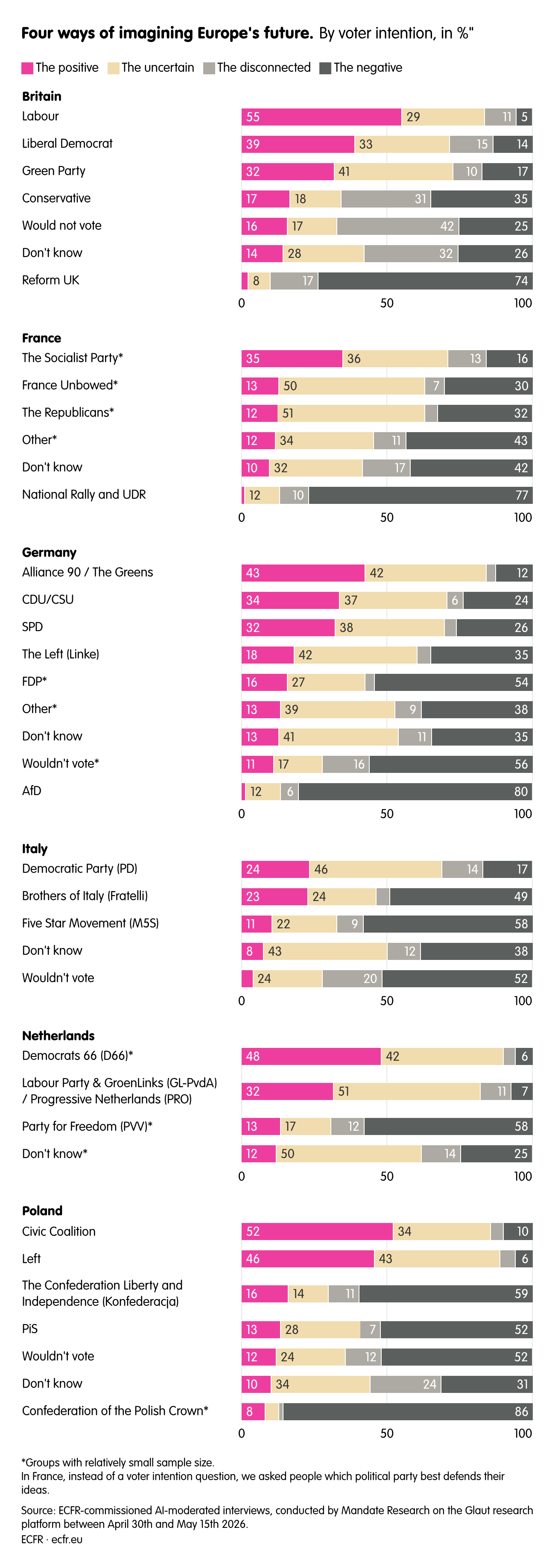
At the other end of the spectrum sit the negative. This is the largest group in every country studied, except the Netherlands, and is home to almost half of respondents in France, Italy and Germany. The negative hold a near-hegemonic position in the electorates of the far-right Alternative for Germany (AfD), National Rally (RN) in France and Reform UK. They are also strongly present on the Polish right and far right, among Party for Freedom (PVV) voters in the Netherlands, and in the electorate of the progressive populist Five Star Movement in Italy. They are well represented among non-voters in Italy, Germany and Poland, too.
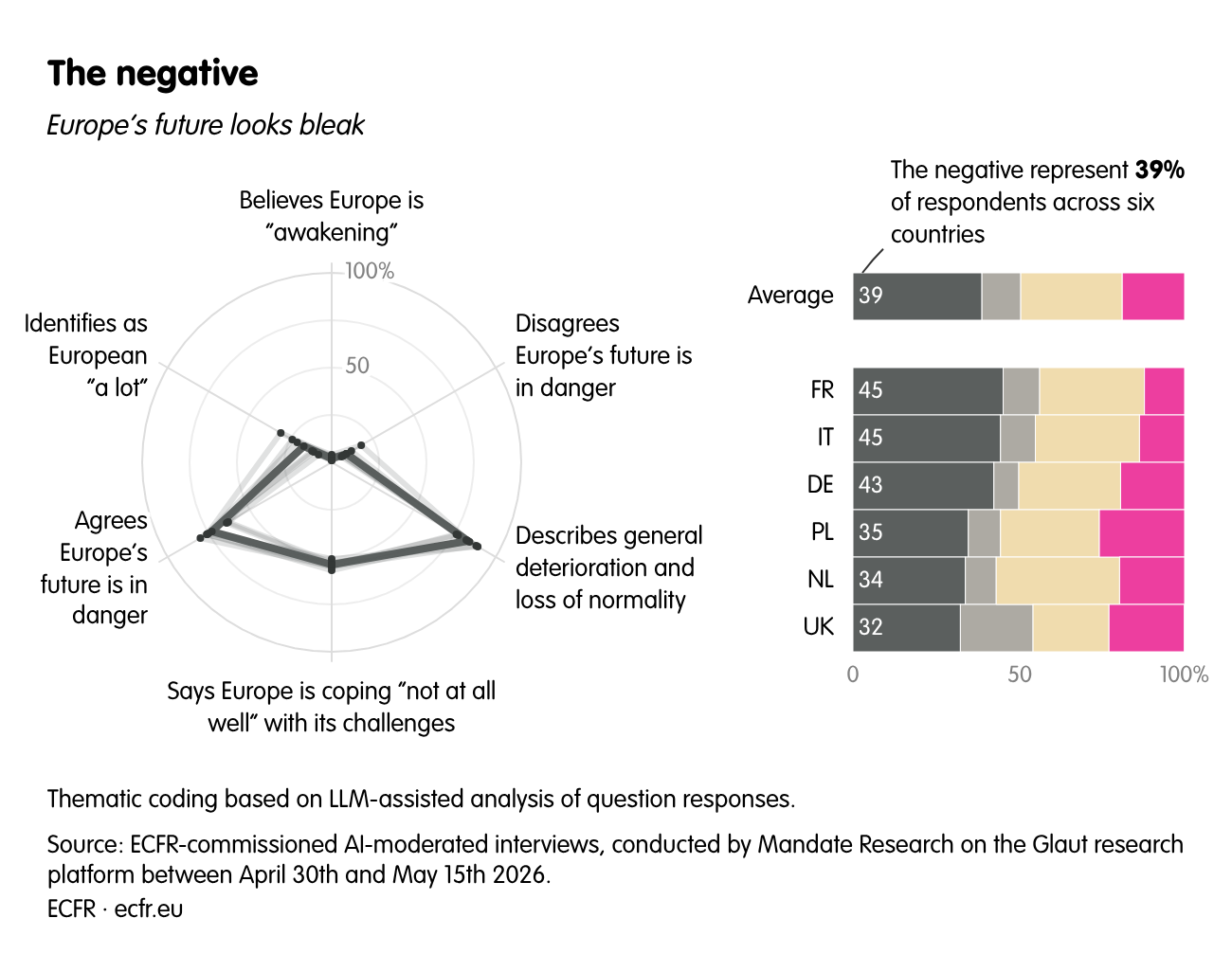
The present: The negative stand out in their strong criticism of today’s Europe, which is characterised by a notable anti-elitist and anti-migrant streak. One Italian, born in the 1980s, describes Europe as: A community run by people who have only thought about their own well-being until now; they’ve ruined our lives with surreal green ideologies, financing unjust wars, opening up to immigration that is destroying European identity and that of member states. [They are] unprepared on the military front [and] divided as peoples both in terms of collective thinking and economically.Read the extended quote from A European from Italy, born in the 1980s
Such pessimism is not always rooted in opposition to European cooperation. Many of the negative instead rail against what they consider the EU’s over-reach: The EU is pushing itself literally everywhere, even into areas where it was never granted any competencies,Read the extended quote from A European from Poland, born in 1980s says one Pole, born in the 1980s, who votes for the radical-right Konfederacja. It is common for people in this group to describe politicians as self-interested, captured by lobbies or too removed from ordinary life to be able to do the right thing. Negatives tend to interpret the crises piling up—and this group cites migration and inflation above all—as symptoms of deeper decay: I feel sad for what once was a great place,Read the extended quote from A European from the UK, born in the 1960s says a Reform UK voter, born in the 1960s.
The future: For most of the negative, Europe’s future looks bleak. But variation exists in how they feel about this. One Pole, who was born in the 1980s and votes for the nationalist Law and Justice party (PiS), agrees Europe’s future is in danger and is pleased about it.Read the extended quote from A European from Poland, born in 1980s Her Italian peer, who votes for the ruling Brothers of Italy party, expresses fear and anxiety: “I am afraid,” she says, before adding, of war.Read the extended quote from A European from Italy, born in the 1980s Asked about her hopes for Europe in 20 years, she mulls whether the EU will still exist. Other negatives actively want the EU to be whittled down or dismantled altogether. As they see it, less or no Europe would restore national sovereignty and give citizens a more direct say in how they are governed. Some of them want to recover what they feel they have lost: We lived much better when the European Union didn’t exist,Read the extended quote from A European from France, born in the 1950s says an RN voter in France, born in the 1950s.
The uncertain
Somewhere between the negative and the positive dwell the uncertain. This group accounts for around a third of the public in most of the countries studied (but only around a quarter in Britain). They are common among the electorates of left-wing parties in all six countries, though they also feature prominently among voters of the ruling centre-right parties in Germany, the Netherlands and Poland.
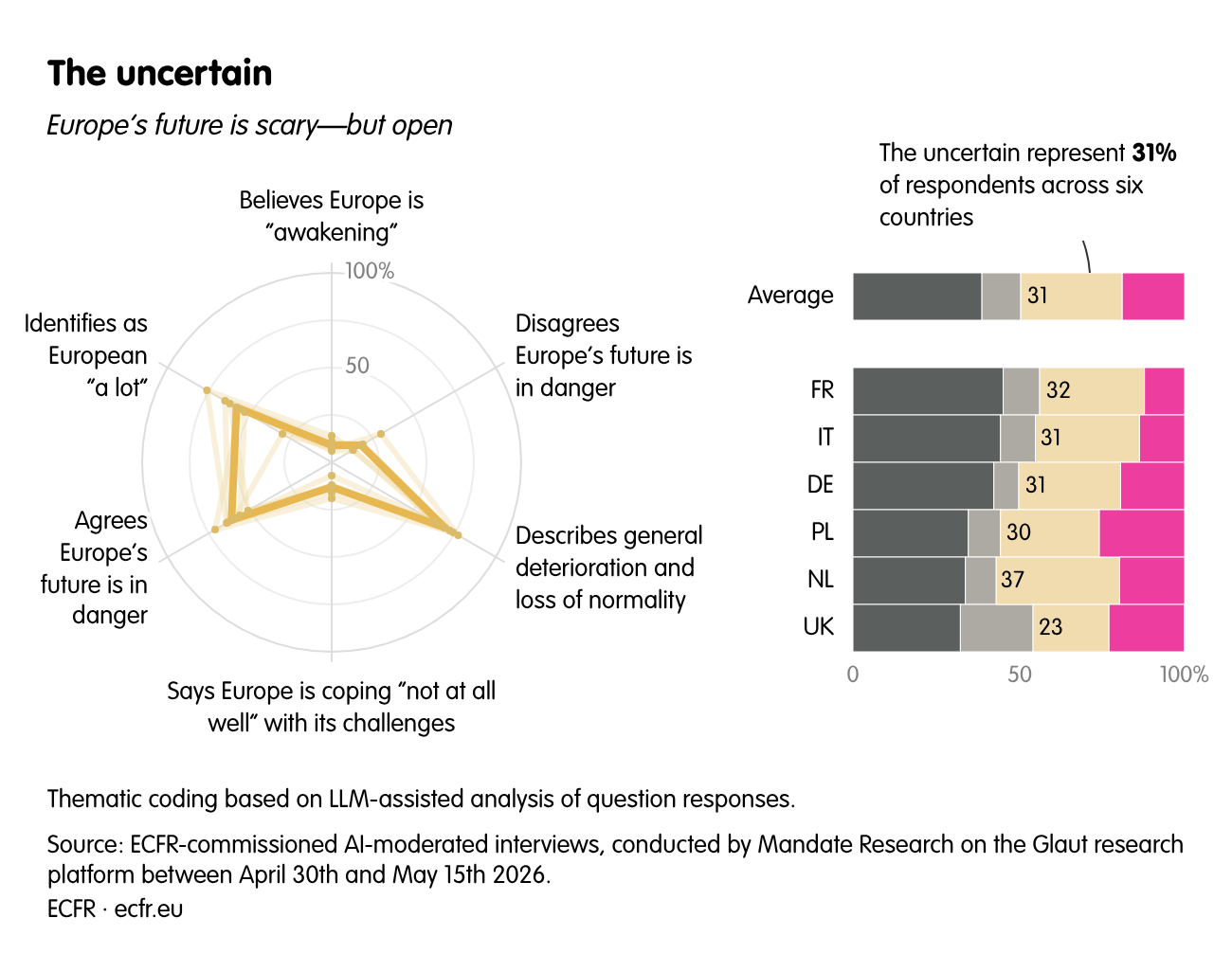
The present: More than half of the uncertain identify strongly as European. Yet they rarely describe Europe today in terms of “awakening” and often bring up themes of decay and loss of normality. Europe is doing badly, the different countries are not united, and we are facing a war on our doorstep,Read the extended quote from A European from France, born in the 1960s says a French respondent born in the 1960s, who votes for Macron’s Renaissance party.
People in this group often see the case for optimism and pessimism alike. They recognise that the EU has made it through crises before and that the threats of today are producing solidarity. They tend to see support for Ukraine, developments in defence cooperation and the gradual reduction of dependence on the US as indicators that something is shifting for the better.
But political will appears fragile to the uncertain. They worry that nationalist and far-right forces could unravel European cooperation and that a gulf exists between European leaders’ words and their deeds. According to a Polish progressive, born in the 1990s, the EU suffers from a lack of a common direction, disagreement amongst member states, poor ideas being implemented by force.Read the extended quote from A European from Poland, born in 1990s Another Pole points to lack of imagination among politicians, the habit that Europe doesn’t need to take responsibility for itself because someone will always save us.Read the extended quote from A European from Poland, born in 1980s
The future: When the uncertain think about the future, they worry. Most of them believe Europe’s future is in danger and what becomes of the EU will depend on choices that leaders have not yet made. Like the positive, most uncertain want Europe to become more united and integrated—but they are much less confident that it will.
A Social Democrat (SPD) voter in Germany, born in the 1960s, hopes for a “solid, united union”. But asked whether this could become reality, he says: I have great doubts about it.Read the extended quote from A European from Germany, born in the 1960s A liberal voter from Italy, born in the 1990s, dreams of a more united, more efficient [Europe], able to harness the strength of its single market and with a long-term vision for the future.Read the extended quote from A European from Italy, born in the 1990s But he doubts this will materialise. Meanwhile, his Dutch peer, who is a D66 voter, hopes for a Europe that is “green, peaceful and safe” but gives just a fifty-fiftyRead the extended quote from A European from the Netherlands, born in the 1990s chance of this vision becoming reality.
The disconnected
The disconnected account for only around a tenth of the public in most countries studied, except in Britain, where (perhaps reflecting the country’s non-EU status and the legacy of Brexit) their share rises to 22%. They feature in the electorates of every party but almost never constitute more than 15%. The only exception is the UK’s Conservative Party, in which they account for almost a third.
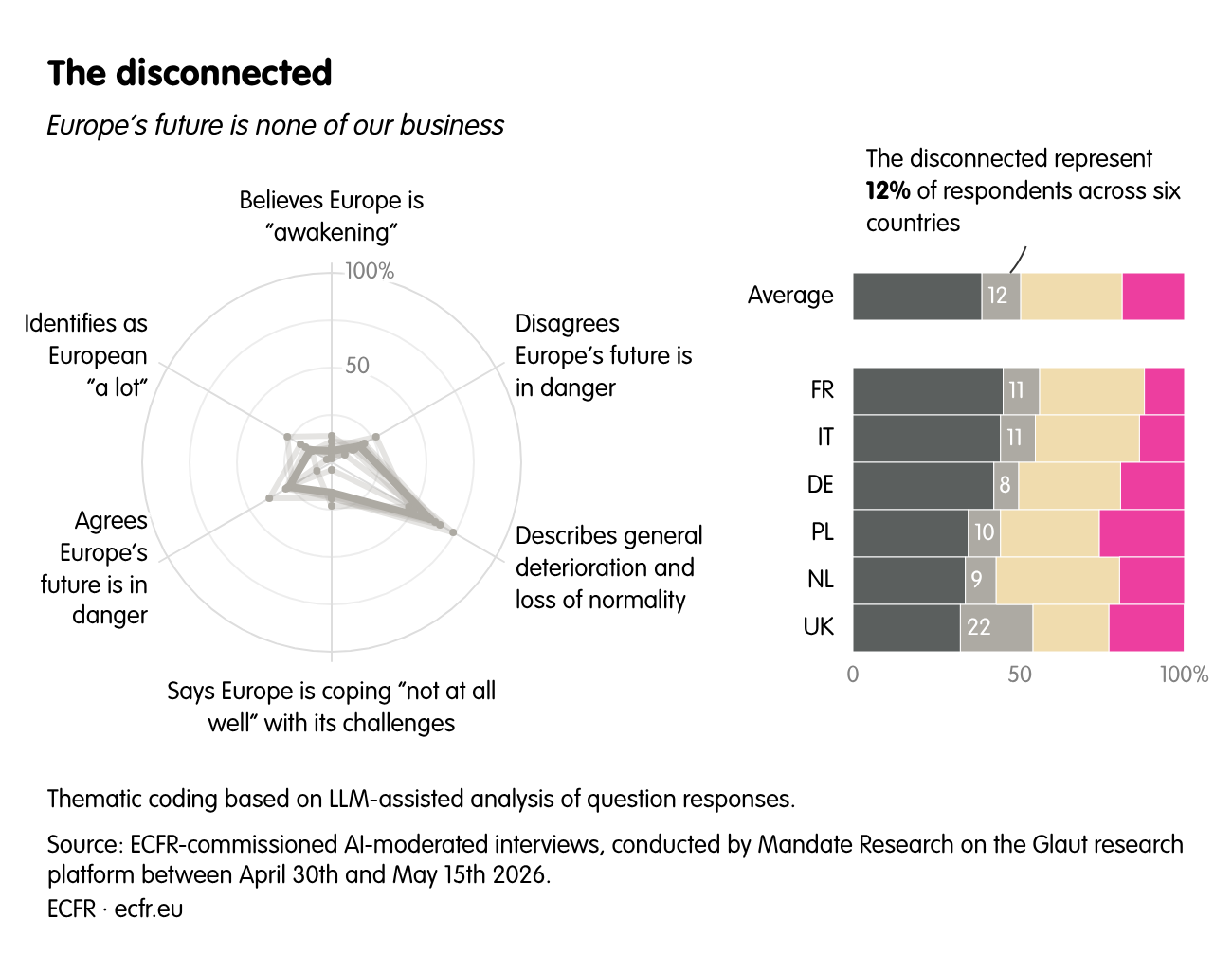
The present: This group sees Europe’s future as largely not their business because they do not experience it as central to their lives (and this often extends to politics in general). I don’t ask myself all these political questions,Read the extended quote from A European from France, born in the 1990s says a French respondent, born in the 1990s. Asked to describe today’s Europe to a friend who had just woken from a five-year sleep, a Pole born in the 1980s replies: Mate. You’ve only just woken up and that’s the first question you’re asking?Read the extended quote from A European from Poland, born in 1980s A Dutch respondent, born in the 1990s, is more direct still: I just live my life the way I want, and Europe or whatever doesn’t interest me.Read the extended quote from A European from the Netherlands, born in the 1990s Their responses to questions concerning Europe tend to be brief and evasive—don’t know, no idea, don’t care.
The future: When asked what they want Europe to look like in 20 years, the disconnected tend to reach for similar answers: more or less the same, no idea, it doesn’t matter. They are animated neither by fear of European collapse nor by hope for European renewal (although many still describe today’s Europe in terms of deterioration or a loss of normality). For the disconnected, the EU is largely a background institution. It occasionally affects prices and makes rules but otherwise feels remote from everyday life and domestic concerns. This group is unlikely to have much say in Europe’s political direction.
That role as a pivotal constituency belongs to the uncertain. This is not to say they are the only ones suffering from an imagination gap. Three-quarters of them are, but so are almost half of the negative and a third of the disconnected. Overall, about half of the European public seem to have an imagination gap. Poland is the exception: only around a third show symptoms there.
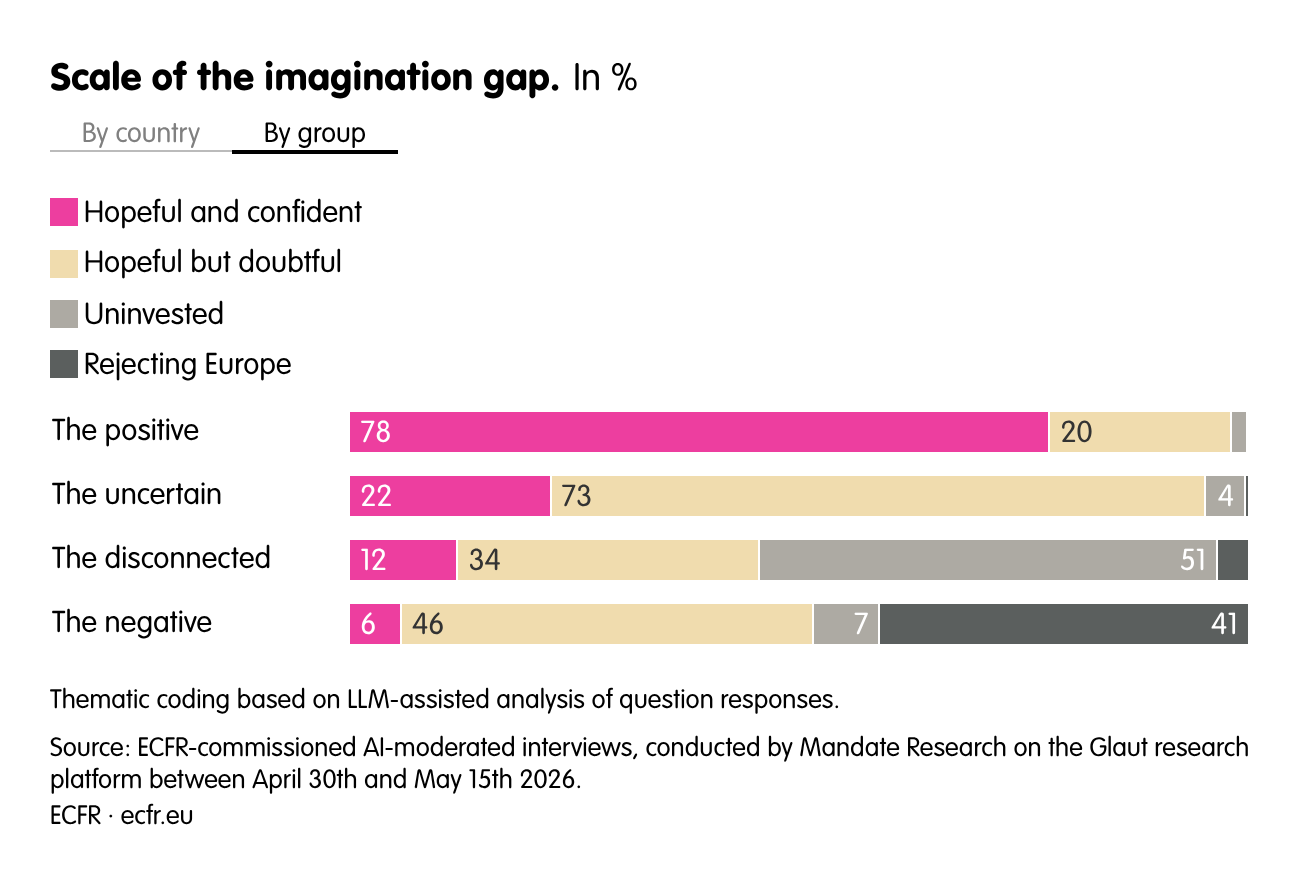
What makes the uncertain so pivotal, apart from the group’s size, is that they have not decided where things will end up. This distinguishes them from the positive, for whom Europe is already succeeding; the negative, many of whom have concluded that it cannot; and the disconnected, who just aren’t that bothered. Pro-European leaders will therefore need to focus their attention on filling the imagination gap among the uncertain, particularly given the growing salience and contestation of the EU in the public debate.
European rhapsody
The dominance of strong opinions about Europe—positive, negative and uncertain—in the interviews aligns with our complementary research across 15 countries. That research suggests “Europe” has become more prominent in the public debate and thus more politically salient. This is corroborated by findings from other research that points to growing identification with Europe throughout the crises.
Three overlapping dynamics seem to be driving these developments.
First, foreign policy upheavals mean geopolitical questions of European power and vulnerability have landed squarely on people’s kitchen tables. Should we prepare for war? Can our countries defend themselves alone? If not, whom should they consider as their key allies—Americans or other Europeans? And is the EU, conceived as a peace project, still fit for purpose in times of “unpeace”?
Second, the EU is becoming “domesticated”. This is because the bloc’s policymaking increasingly reaches into some of the most politically sensitive areas of people’s lives (migration, climate and the cost of living, for example). Some member states, like Greece and Cyprus, experienced this well before others. In their case, the euro-zone crisis led to a lasting slump in public trust towards the EU.
But now the EU is in the limelight almost everywhere, in part because of Brussels-led policy initiatives. These policy choices are testing people’s vague or instinctive pro-Europeanism against consequences they feel. Should the EU spend more on defence? Is it a good idea to ban plastic straws, or phase out diesel cars and fossil fuel boilers? Should all European countries have mandatory refugee quotas? Such decisions can nudge European citizens towards developing more concrete pro-European attitudes. But they can also make their views more conditional, critical or ambivalent.
Finally, some political actors are stoking the culture wars. As I argued in last year’s Sentiment Compass, “Europe” is a target in the Trumpist political project and those of like-minded forces on this side of the Atlantic. Some well-known social media moguls and platforms play an active and polarising role in this. European far-right politicians need not support Trump or advertise closeness to his administration to draw on a similar repertoire: Brussels is bureaucratic; Europe is weak; the mainstream is ideologically captured; European institutions are obstacles to national sovereignty and cultural authenticity. Such narratives contest what “Europe” is for. They also call into question whose values it represents and whether its institutions deserve citizens’ allegiance.
This is not to say greater salience always translates into less support for a stronger, more united Europe. It can also open up space for a more serious debate in which pro-Europeans can clarify and update the case for integration. Geopolitical insecurity, for example, can strengthen the perceived value of European cooperation in the eyes of the public, as a growing pro-Europeanism of Danes and Swedes suggests.
The politicisation gap
But greater salience can push people to start feeling anxious about Europe’s future. It also strengthens the temptation for political forces to convert the EU into one of the main political and electoral battlegrounds. This is especially the case on the far right. The AfD’s co-leader Alice Weidel, for example, has called for Germany to leave the euro zone and the Schengen area; President Karol Nawrocki in Poland attacks European “follies”. They and others, like RN leader Marine Le Pen, seem to have concluded that trolling the EU gives them a language through which they can explain who they are. Such figures also use it as shorthand for what they oppose and what future they offer.
Pro-European political leaders often struggle to respond with the same confidence. Some react with unconditional defence of the EU (for instance, the Dutch prime minister Rob Jetten and his Spanish counterpart Pedro Sánchez). But that can stop them addressing people’s anxieties about Europe. Other leaders, including Donald Tusk in Poland and Friedrich Merz in Germany, offer a trimmed pro-Europeanism instead (for example, by posing as “realist” on migration and climate). This might bring them closer to a median national voter, but it also risks making far-right views about Europe look more normal.
Leaders thus tend to preach to the positives or bow down to the negatives. Yet it is among Europe’s uncertain that belief in Europe’s future is up for grabs. If the uncertain’s anxieties remain unaddressed, they could veer away from pro-European parties or even detach from politics altogether. And if people choose not to vote or to vote for far-right or Eurosceptic parties in their national elections, the entire continent could move in a direction that renders it unrecognisable in 20 years’ time. This is not to mention that it could become more vulnerable to Russia and even Europe’s old friend across the Atlantic.
One example of how things could be done differently comes from Romania. Speaking on television on Europe Day, President Nicusor Dan offered a nuanced view. He accepted that Europe has made mistakes, but at the same time defended its capacity for self-correction. In a country that has become highly polarised, this may have been an instinctive appeal to Romania’s version of the uncertain.
Other pro-Europeans who take the uncertain seriously may also be able to come up with a better response. In their voting preferences and media habits, the uncertain resemble the positive much more than the negative. (For more evidence, see the bonus track at the end of this paper.) Yet, when asked about Europe’s future, they do not share the positives’ confidence. And if these voters already inhabit relatively pro-European political and media environments (and, as discussed, identify strongly with Europe), their doubts cannot be explained only by exposure to Eurosceptic parties, hostile media and culture wars. Something other than old-school pro-Europeanism might thus be necessary to make them believe in Europe again.
Chords of doubt
Three recurring concerns appear to be holding the uncertain back: they doubt whether Europe can act when it needs to; whether it can live up to the values it professes and command respect; and whether it can really keep Europeans safe.

European slowness
One of the most striking findings from the interviews was that, across the six countries, respondents often mention Europe’s “slowness” as one of its most frustrating characteristics. This theme comes up most often in the Netherlands and Germany (where Merz once criticised the EU’s “massive over-bureaucratisation of almost all parts of life”). Positive and negative respondents also mention slowness, but the uncertain talk about it even more than any other group.
Many of the uncertain focus on the pace of decision-making. One millennial German, who voted for the centre-right Christian Democrats (CDU/CSU) in 2025 but now prefers the SPD, complains that “the bureaucratic apparatus is far too large and cumbersome. It takes far too long for a decision to be made. Some issues need to be addressed quickly, but by the time everything has gone through all the levels and member states, it’s usually already too late.” Asked who is responsible, he blames both sides: EU institutions are too bureaucratic and bloated, and the member states don’t want to give up any responsibility or authority whatsoever.Read the extended quote from A European from Germany, born in the 1980s
For others, the problem is more structural. As a young Pole, born in the 2000s and looking beyond the mainstream parties, puts it: “The EU fundamentally discusses a lot but does nothing.” He attributes this partly to the culture of operation of the states with the greatest influence in the EU.Read the extended quote from A European from Poland, born in 2000s A Bavarian, born in the 1970s, who voted CDU/CSU in 2025 but is considering switching parties, says: Everything takes far too long. By the time Europe reaches agreements, years have passed or nothing happens because one EU country is against it.Read the extended quote from A European from Germany, born in the 1970s Her solution is to replace unanimity with, for example, a three-quarters majority. Similarly, a Dutch respondent who used to vote for the centre-right People’s Party for Freedom and Democracy, born in the 1970s, complains about Lengthy consultations [and] little or slow decision-making,Read the extended quote from A European from the Netherlands, born in the 1970s blaming member states for this.
But something else emerges from these conversations besides familiar complaints about Brussels bureaucracy. In a faster-moving and more dangerous world, slowness becomes a measure of Europe’s (in)ability to act.
A German man, born in the 1960s, links cumbersome procedures to declining competitiveness: If a simple approval procedure in Europe takes years and sometimes decades, nobody can compete with such an industry-friendly society as in the USA, China or India.Read the extended quote from A European from Germany, born in the 1960s His compatriot, a Green voter born in the 1990s, goes further, describing Europe as being “in an odd in-between state between the old and a new world order”. Because of regulation and bureaucratic hurdles, she argues, Europe is not really able to adapt quickly enough and is being massively overtaken technologically by Asia and the USA.Read the extended quote from A European from Germany, born in 1990s
So, slowness makes the future the uncertain want hard to believe in. If Europe aspires to become more sovereign and competitive, as several European leaders have promised, then the uncertain first need to see evidence that the EU can make decisions and implement them—and that it can react quickly enough to the fast-changing global environment. This might require the EU to eliminate national vetoes in some areas. Or smaller groups of countries could lead on some initiatives when unanimity between countries is impossible to reach. But whatever the actions, they need to challenge the overwhelming impression of Europe being unable to act. Otherwise, too many people will continue to have the same impression as a British Labour voter, born in the 1990s, according to whom Europe simply feels slow.Read the extended quote from A European from the UK, born in the 1990s
European hypocrisy
The second chord of doubt relates to perceptions of Europe’s lack of integrity. This theme is most common among the negative, but the uncertain also raise it fairly often. It comes up regularly among uncertain supporters of more radical left-wing parties, like LFI in France, Die Linke in Germany, and the Green Party in Britain. Yet the negative and uncertain focus on different things. The negative tend to focus on the dishonesty and hypocrisy of the political class; the uncertain are more likely to point to moments when Europe disappointed them.
Complaints among the uncertain take two main forms: Europe failing to live by the values it professes, and Europe failing to stand its ground when confronted by more powerful actors.
On double standards: “First the silence. Then the hypocrisy”, says an LFI voter who was born in the 1990s. Russia attacks Ukraine; Russia is the villain. Israel attacks Palestine, but they’re terrorists. It doesn’t make sense.Read the extended quote from A European from France, born in the 1990s
On a lack of courage, the EU’s tariff agreement with Donald Trump’s administration seems to have become a powerful symbol. A Die Linke voter in Germany, born in the 2000s, says he felt “terribly ashamed” when “von der Leyen just caved in to the US”. He found it “really embarrassing personally, that we capitulated so hard”. For him, the episode represented something larger: Every time the EU capitulates, it shows … we don’t want to do anything and would rather cling to the old status quo.Read the extended quote from A European from Germany, born in the 2000s
The disappointment about the tariffs crosses political boundaries. A Renaissance voter in France, born in the 1950s, was similarly ashamed of the tariff agreement. She saw it as Letting ourselves be led by the nose by a madman,Read the extended quote from A European from France, born in the 1950s and used even stronger words to describe what she saw as von der Leyen’s submission to Trump.
Nor does the accusation come only from those who want Europe to confront America or Israel more forcefully. A German, born in the 1980s, who previously voted Green but has since shifted towards Die Linke, is disappointed by what she considers insufficient support for Ukraine. “The usual hypocrisy,” she says. Words are easy to say—actually providing real help is another matter. It requires genuine action.Read the extended quote from A European from Germany, born in the 1980s
This is particularly damaging given European leaders’ rhetoric about sovereignty and independence. The uncertain observe a distance between the Europe they are told is entering its “independence moment” and the one they see backing down when confronted by a stronger power. This does not mean they reject compromises as such, given compromising is something all political actors need to do. But for many uncertain, giving in on values is a no-go. One German, born in the 2000s, was also ashamed of the tariff agreement with Trump but saw it as a demonstration of a broader pattern: The EU no longer stands unreservedly behind its values. Everything becomes a compromise solution; no solution is confined to true values.Read the extended quote from A European from Germany, born in the 2000s
As the “Samples of hope” section will show, shared values come first when the uncertain are asked to explain what being European means for them. So, when leaders in Europe appear to be compromising on these values in their foreign policy, this not only tarnishes Europe’s image abroad but also comes with a political cost at home. The challenge for leaders is to show that people can still take seriously both the values Europe professes and the claims it makes about its own power.
European insecurity
The third chord of doubt is about people’s feelings of insecurity. Half of the uncertain describe war and security as Europe’s greatest challenge. The positive mention it just about as often, but they also tend to refer to the more strategic notion of “geopolitical autonomy” (which fewer of the uncertain do); the negative divide their attention more evenly between inflation, immigration and war.
The uncertain tend to connect insecurity to broader European vulnerabilities, such as dependence on America. They also talk about the EU’s internal divisions and the rise of the European far right. The USA will increasingly withdraw and Europe must be able to defend itself,Read the extended quote from A European from Germany, born in the 1980s says a German, born in the 1980s, who previously voted SPD and now leans Green. She links this to concerns about the possibility of the AfD entering government and the divisions this could create in the face of Russia. A progressive Dutch voter, born in 2000s, makes a similar connection: I’m worried about poor cooperation and that Europe is therefore less resilient to external threats—for example Russia, but also the US which wants to portray Europe as weak.Read the extended quote from A European from the Netherlands, born in the 2000s
This is not far removed from the positive vision of a more autonomous Europe. The difference lies in the extent of the imagination gap. A Renaissance voter in France, born in the 1950s, describes “war on Europe’s doorstep” as a major problem. But thinking about Europe’s response makes her feel Europe is doing what it can, but it doesn’t actually have the means.Read the extended quote from A European from France, born in the 1950s
Finally, one Italian Five Star Movement voter, born in the 1960s, connects insecurity back to Europe’s slowness. “The first [challenge] is certainly security because the war near our borders has changed the general atmosphere,” she says. But Europe is not tackling it well because there is often a lack of speed and unity in decision-making.Read the extended quote from A European from Italy, born in the 1960s
The imagination gap among the uncertain thus comes from things they believe they can observe. They see decisions that take too long, aspirations that sound hollow and threats Europe may lack the means to confront. To close the gap, leaders will have to offer more than an attractive vision of the future. They will have to show people Europe can act, command respect and protect them.
Samples of hope
Still, if everything were gloomy in the world of the uncertain, they would belong among the negative. Like the positive, though, they often invoke shared values and principles when explaining what being European means to them. When asked what they would like Europe to look like in 20 years, many hope for greater European unity and political integration. They can also usually identify moments when Europe made them proud.

All these can serve as potential “samples of hope” for pro-European leaders to reconnect with the uncertain. But two aspects appear politically the most crucial: their memories of when Europe made them proud and the type of leadership they admire.
Memory bank
Politicians need to be able to tap into people’s best memories about Europe. When asked about moments when they felt proud of Europe or of being European, the uncertain can usually reach into their own experience and find evidence of Europe behaving in ways they value. This suggests that their attachment to Europe does not come from aspiration alone.
The examples differ widely and reflect the varied national histories of the respondents. They also come from people’s diverse political outlooks and personal experiences—from witnessing the opening of borders to participating in the Erasmus programme of academic exchange.
More than 70 years since European integration began, people still recognise how remarkable the beginning of the story was (even if they were born decades later). As a young Pole, born in the 1990s, says, Europe emerged from a tremendous crisis after the [second world] war and rose above its divisions—that’s a great reason for pride.Read the extended quote from A European from Poland, born in 1990s
Her German peer, a Die Linke voter, remembers feeling proud When we collectively took in refugees during the [2015] refugee crisis.Read the extended quote from A European from Germany, born in 1990s Another German of similar age points to the moment when we supported Ukraine and restricted the USA regarding Greenland.Read the extended quote from A European from Germany, born in 1990s
A French respondent, born in the 1950s, remembers the 2015 terrorist attacks in his country and the solidarity they generated across the continent: I had the impression that Europe was entirely with us, the French, and I felt proud to be part of this union.Read the extended quote from A European from France, born in 1950s
A Briton, born in the 1980s, points both to the EU’s “big bang” enlargement in 2004 and to Europe’s united response after Russia’s invasion of Ukraine, which showed that we had a common sense of ideals.Read the extended quote from A European from the UK, born in the 1980s Another British respondent, born in the 1950s, cites Europe’s solidarity and courageRead the extended quote from A European from the UK, born in the 1950s in standing up to Trump and staying out of the war in Iran.
For an Italian, born in the 1990s, the defining moment was the covid-19 pandemic, when European institutions intervened with economic support and helped secure vaccine distribution. What impressed him was that for once the interests of individual countries were set aside to advance a broad-reaching, visionary and solidaristic intervention.Read the extended quote from A European from Italy, born in 1990sA much older Italian recalls the 1976 earthquake in Friuli and the aid received from other Europeans.Read the extended quote from A European from Italy, born in 1940s
People’s national experiences offer particularly vividry’s accession to the EU, and the freedom of movement that followed. In the Netherlands, respondents mention the introduction of the euro and European support for Ukraine—but also, rather wonderfully, the Eurovision Song Contest.Read the extended quote from A European from the Netherlands, born in 1990s
The pattern underneath these scattered memories is that people tend to feel proud when European countries act collectively in accordance with something respondents value. When the EU shows solidarity, for example, or protects freedoms. Or when the bloc overcomes national divisions to stand up to external pressure. Or when the EU shows European cooperation can make things happen that individual countries could not achieve alone.
This is almost the mirror image of the hypocrisy described in the previous section. Shame arises when Europe’s leaders proclaim values but fail to act on them, or talk about power while appearing unable to exercise it. Pride wells up when words and actions come together.
These memories thus provide something the uncertain otherwise struggle to find: evidence that collective European agency is possible. Europe has acted. It has overcome national differences. It has shown solidarity. It has occasionally behaved with the ambition and courage the uncertain would like to see more consistently.
Given how much bad news about Europe people see, any piece of good news has a strong chance of standing out and being remembered. Indeed, some people actively seek out more promising stories. One example was the defeat of Viktor Orban in Hungary after 16 years in government. This was fresh in respondents’ minds at the time the interviews took place and was mentioned more than sporadically in the conversations, including among the uncertain. They would certainly welcome more good news like this.
Faces of change
The second sample of hope might prove politically harder to act on. This is about national leaders being able to offer principled leadership at the European level, so that the promise of Europe’s renewal can have a face attached to it. The song of Europe needs its lead singers to tell, and show, people who the leads are—not only who and what they are against.
As things stand, respondents struggle to name any countries, institutions or political figures that would represent, in their eyes, positive examples of European action. Almost half of the respondents (44%) fail to mention anyone; this is also the case among the uncertain. When they do mention someone, they often point to their own country or the leader of the party they vote for.
One European leader bucks this trend: Sánchez. Across the six countries polled (which did not include Spain), 8% mentioned Sánchez specifically, or Spain under his watch, as positive examples. No other country or leader generated comparable admiration. Sánchez and Spain proved especially popular in Italy, where (quite remarkably) a quarter of respondents referred to them, and in France, where 1 in 10 did. In both places, left-wing voters were particularly fond of the Spanish example. And the popularity of Spain and Sánchez was equally visible among positive and uncertain voters, with 10% of each group mentioning them as an example worth following.
According to a Five Star Movement voter in Italy, born in the 1960s, perhaps the one who seems to want to do something is Sánchez.Read the extended quote from A European from Italy, born in 1960s A German Green voter, born in the 1950s, shares that feeling. A good example? Spain. Excellent how Mr Sánchez stands up to the USA,Read the extended quote from A European from Germany, born in 1950s she says. Another Italian, born in the 1960s, offers a glimpse of what some voters might consider so worthy of admiration. What role would she like Europe to play in the world? It should have the courage to say no, as
Sánchez has already done in Spain,Read the extended quote from A European from Italy, born in 1960s she says. The Italian quoted at the beginning of this section was more direct still.
Sánchez is a controversial figure. His country lags the rest of Europe in terms of defence spending, even if it has raised its level from previous lows. He is unpopular at home and often seen as using international activity to repair struggling domestic ratings. He does not have many friends in other European capitals, and even fellow social democrats from Denmark criticised his government’s migration policy in reaction to events in Ceuta over the summer. And as the leader of a country far away from Russia and Ukraine, he can afford more assertiveness vis-à-vis the US than his peers in Berlin or Warsaw.
But it is hard to dismiss the fact that today hardly any European leader offers an equally principled foreign policy stance. It is also rare for leaders to place Europe so centrally in their politics, and say things like: “We defend Europe because we can no longer conceive of any other way of being and existing in the world,” or, “the EU is the greatest project of peace and unity in history.”
Macron used to offer a similar form of leadership, using his speeches and interviews to urge other countries to boost Europe’s strategic autonomy. But, as he prepares for retirement and deals with a divided parliament, his star has clearly faded. Across the six countries studied, just 4% mention him as a positive example (though this still puts him in second place). And apart from these two, hardly any other politician not from the respondent’s own country—not even von der Leyen—is mentioned more than sporadically as a positive example. Undoubtedly, there is a vacuum here.
Taken together, the conversations suggest that the foundations for belief in the future extend well beyond committed Europhiles. The uncertain retain a language of European belonging, a relatively clear sense of the Europe they would like to see, and memories of moments when collective European action made them proud. Yet they still need convincing that the moments of pride can become the norm in the future, not exceptional memories of the past. And Europe often lacks leaders the uncertain consider an example worth following.
Future nostalgia (reprise)
Pro-European leaders cannot afford to be naive about the contested information environment in which arguments (and falsehoods) about Europe circulate. But Europe’s imagination gap cannot be fact-checked away or repaired with the help of influencers alone. Many of the doubts our interviews uncovered come from what people believe they can see with their own eyes. The uncertain and many people in other groups resent decisions that take too long and principles that the EU applies inconsistently. They also see a continent that still seems unable to guarantee its own security or even stand up to those who threaten it. These are matters of policy as much as communication.
In their policymaking and communications, pro-European leaders should take a broader political lesson from our research. This paper has shown how geopolitics and culture wars combine with the domestication of EU policy to increase the salience of Europe in national political competition. But the mainstream has too often participated in this politicisation by offering an unconditional defence of Europe against its critics or by ceding ground to them.
The problem with blind defence is that it polarises voters into “for” and “against” Europe. Some leaders therefore risk treating people’s doubts about Europe’s performance as evidence of insufficient commitment. This could end up alienating the uncertain voters who identify strongly with Europe but who doubt whether what they want for the continent will come to pass. By moving closer to Eurosceptic or far-right views, other leaders allow their opponents to define what is wrong with Europe and what policies might rectify that.
So, pro-European leaders need to take back control of Europe’s politicisation. They should start by going beyond defence of the status quo. Uncertain voters already want the things the mainstream defends, but they worry that something not quite as rosy may lie ahead. To address these anxieties, leaders should acknowledge Europe’s slowness and inconsistencies. They should also speak openly about the EU’s policy failures. But they must offer clear ideas of their own about how to correct them, spelling out why dismantling the capacity Europeans have built together will do nothing of the sort.
But Europe’s mainstream also needs to change its relationship with time. When EU and national leaders alike offer grand visions but do not show how they intend to get there, people seem to doubt they ever will. But showing only small steps with no clear destination looks like crisis management. Leaders need to connect the two more explicitly.
If they do not, the past may become an even more attractive place for people to look for direction. Nostalgic politics thrives on offering familiarity in place of possibility, repackaging versions of yesterday as answers to tomorrow. This is proving only too successful. Far-right parties lead in the polls in several member states, with the AfD winning the largest share of votes in a regional election in Germany in early September. The same weekend as the AfD’s seismic triumph, Britain saw masked protesters clad head to toe in black march on the south coast, just after Reform UK leader Nigel Farage signed a pact with Le Pen’s protégé Jordan Bardella to “stop the boats” crossing the English Channel. All these parties and their many kin across Europe sell the vision of the past as the future. All these parties, in power, would also likely attempt to enact policy agendas to weaken Europe and dismantle its frameworks of cooperation.
Pro-European leaders urgently need to put Europe’s past to work for a different purpose. The conversations in this paper are full of memories of moments when Europe acted collectively, overcame national divisions, stood by its principles or simply made people proud to belong. Leaders will need to help those memories become evidence: reminders that European collective action is possible and that periods of crisis need not last forever. This is the possibility contained in “future nostalgia”. Its promise lies not in a longing to return to yesterday, but in a desire to gain a sense that the tomorrow people want is within reach.
Practical politics with a horizon
So, Europe needs practical politics capable of reproducing future nostalgia. Proponents of European integration once excelled at creating expectations and turning some of their most ambitious plans into reality. Europeans gained a sense of direction from successive waves of enlargement, the removal of borders and the introduction of a common currency. The future exerted a pull on the present.
Today, the direction seems reversed. Politicians manage one emergency after another, while the future increasingly appears to be something threatening. Some of these threats are existential, like war creeping ever closer and the climate disruption that landed so forcefully on Europeans’ doorsteps this summer (and the summers before that). Some are less immediately perceptible, such as Europe’s technological decline and economic “slow agony”. Some, like demographic ageing, are more generational. Others, such as “civilisational replacement”, are based in conspiracy theories but nonetheless provoke anxiety among parts of Europe’s population.
Telling people to “dream big” cannot overcome such a range of fears for the future. Pro-European leaders instead need to govern the present in ways that make a better future imaginable. Future nostalgia therefore describes a capacity that European politics has lost—and might recover—rather than a mirror image of the backward-looking politics it seeks to counter.
Again, the way national leaders respond to Europe’s politicisation will be important. As Europe has become more domesticated, issues like migration that citizens experience as national and personal are increasingly becoming debates about “Europe” itself. So far this has often worked to pro-Europeans’ disadvantage because Europe becomes implicated in people’s grievances; the EU becomes associated with the costs and constraints of policies that touch their everyday lives.
Leaders instead need to make European action today part of a practical account of how they intend to improve people’s lives tomorrow. Many of them have to date struggled to tell this side of the story, leaving Europe’s critics freer to define integration primarily through its costs, constraints and risks. This also gives Eurosceptics space to sell the illusion that the future would be so much easier with less integration.
To reach beyond the most committed Europe-believers, pro-Europeans cannot simply say: “Vote for me because I believe in Europe.” Nor can they tell people to “accept this painful policy because Europe requires it.” Their arguments need to be more concrete: “Here is the problem you care about today. Here is what we can do nationally. Here is what we cannot do nationally and where we need other Europeans. And here is what that combination could make possible five years from now.” If getting there requires changing the way the EU works today, so be it. But those reforms should not become another abstract European project that looks like a distraction; leaders really need to show what policies would bring the desired future within reach.
That would amount to a rather different kind of European politics. It would cast “Europe” as neither an identity proposition nor a distant dream. Europe would instead become part of the causal chain connecting the problems people feel now to tomorrow’s improvements. Pro-European leaders’ task is thus to show people where Europe’s unfinished song is going rather than keep on promising a future masterpiece. It is also to show the public, measure by measure, that Europe is truly capable of keeping the record turning.
Methodology
This paper draws on 5,834 AI-moderated interviews (AIMIs) conducted by Mandate Research on Glaut—a market research platform focused on AI-moderated voice interviews. The interviews were conducted between April 30th and May 15th 2026 across six European countries: France (815 interviews; May 5th-15th), Germany (1,253; April 30th-May 13th), Italy (1,039; April 30th-May 14th), the Netherlands (556; April 30th-May 15th), Poland (989; April 30th-May 15th), and the United Kingdom (1,182; April 30th-May 7th).
Participants were recruited from an online panel provider using quota sampling. After an initial pre-survey, respondents were asked whether they consented to take part in the AIMIs; 5,834 of the original 9,757 respondents (60%) consented to participate and subsequently completed the interview. These final interviewees were weighted according to their demographic and political characteristics to ensure the final sample aligned with the profile of each country’s adult population.
Each interview followed a structured discussion guide. Because the UK was the only non-EU state included in the research, the discussion guide here differed somewhat from the one used in other countries. Interviewees chose between conducting the conversation by providing audio responses (21%) or through a written chat (79%). On average, the interview took just under 18 minutes to complete. Responses were subsequently transcribed, machine translated into English and thematically coded with AI assistance.
The taxonomy of the four segments (the positive, the negative, the uncertain and the disconnected) was designed by the author based on the analysis of the data and interviews. Each interview was allocated to one of the four segments using AI-assisted coding to help manage the large volume of interviews. The research team provided a large language model (LLM) with detailed definitions of these four groups (see below). Acting as a digital research assistant, the model read through each interview, evaluated the respondent’s view of Europe’s future, and—based on the guidelines—assigned the most fitting label to each conversation.
For the purposes of the coding, the following definitions of the four groups were used:
- The positive: “Those who feel European, and even if they are concerned about Europe, they still retain hopes about the continent’s capacity to surmount the current challenges. Some of them might feel proud of how it’s already dealing with those, but this is not a must to qualify for this group. The key criteria are feeling European and seeing the light, even if it’s only at the end of a long tunnel.”
- The negative: “Those who are the most critical about Europe, the EU, its leadership and where the things are going. They might still be concerned—but for them Europe’s problems might largely be proof that European integration was a bad idea in the first place.”
- The uncertain: “Those who feel European but have much less confidence about where things are going. They might display some ambivalence, for example: great hopes, little confidence; or strong attachment to Europe but major disenchantment with leaders.”
- The disconnected: “Those who do not necessarily feel European that much and therefore, whatever the state of Europe or its imagined future, it does not concern them that much. They might often lack an opinion or their opinions might be very brief, basic and superficial. They seem as though they do not really care about Europe and its future.”
Similarly, the AI helped to assess the scale of the “imagination gap” by allocating respondents to groups based on the following definitions:
- Hopeful but doubtful: “Expresses a clear desire, hope or preference for a positive future (unity, peace, prosperity, geopolitical strength, democracy, environment, and so on) for Europe, but simultaneously expresses scepticism, pessimism or significant doubt that this future will actually materialise. They want the European project to succeed but feel constrained by current political, economic or social realities.”
- Hopeful and confident: “Expresses both a desire for a positive European future (unity, peace, prosperity, geopolitical strength, democracy, environment, and so on) and genuine belief or confidence that this future will come to pass. Their positive hopes align directly with their positive expectations for the future.”
- Rejecting Europe: “Expresses a hope or desire for less Europe/EU involvement in the future or the dissolution of the EU. This includes individuals who are actively opposed to the European project and believe it is fundamentally flawed.”
- Uninvested: “The participant is disengaged on the question of Europe and their future expectations or the participant does not discuss their personal hopes, dreams regarding Europe or the EU”
For this paper, AIMIs were complemented by qualitative research on public and political debates in 15 European countries: Bulgaria, Cyprus, Denmark, France, Germany, Ireland, Italy, Lithuania, the Netherlands, Poland, Portugal, Romania, Slovakia, Spain and Sweden. This comparative desk research examined how Europe is discussed and framed across different national political and media environments. It was carried out—in June 2026, using a standardised questionnaire—by ECFR’s staff and through ECFR’s network of associate researchers.
About the composer
Pawel Zerka is a senior policy fellow at the European Council on Foreign Relations. As lead analyst on public opinion, he spearheads the organisation’s polling and data research on foreign affairs.
Credits
The author would like to thank the European Cultural Foundation (ECF)—especially André Wilkens, Isabelle Schwarz and Tsveta Andreeva—for their unfailing interest and support in exploring the nexus between culture and foreign policy, and for their confidence in developing the European Sentiment Compass as a joint ECFR-ECF partnership and initiative: already in its fifth consecutive year!
The use of AI-moderated interviews for this study would not have been possible without the close assistance of and prior inspiration from our colleagues at Mandate Research who were responsible for the technical and operational part of this endeavour. In particular, Alex Hymer has been a tireless partner in conducting the analysis.
This project is also based on qualitative research conducted by ECFR’s associate researchers, whose hard work needs to be recognised. They included: Hüseyin Silman (Cyprus), Christine Nissen (Denmark), Stephan Naumann (Germany), Harry Higgins (Ireland), Alberto Rizzi (Italy), Justinas Mickus (Lithuania), Niels van Willigen (Netherlands), Lívia Franco (Portugal), Oana Popescu-Zamfir (Romania), Matej Navrátil (Slovakia), and Ludvig Broomé (Sweden). Our colleagues at ECFR offices in Madrid and Sofia—Carla Hobbs, Irene Olombrada, Maria Simeonova and Alexander Velichkov—provided research on Spain and Bulgaria. (The author covered France and Poland, the two countries he knows best.)
A project of this scale is inevitably the result of teamwork. It would be hard to overstate the contribution of Kim Butson, who demonstrated incredible patience, meticulousness and ingenuity as editor. Jeremy Cliffe and Adam Harrison provided sage advice. Special thanks go to Chris Eichberger for graphic design, Nastassia Zenovich for data visualisations, Martin Tenev for his brilliant web design, Andreas Bock for managing the communication side of the project, as well as Angela Mehrer and Karel Solar for leading on the advocacy side. And the author would not get very far without the trust of Susi Dennison and Anna Kuchenbecker, who have supported this project since its inception in 2021.
We are also grateful to MEP Michal Wawrykiewicz for offering the opportunity to discuss this paper in the European Parliament on its launch day; and to MEP Hannah Neumann for accepting our invitation to speak at that event.
Finally, big thanks to Dua Lipa for offering such a well-fitting framing. We will be happy to explore further collaboration.
This year’s project has also been supported (in part) by a grant from the Open Society Foundations.
Any mistakes or omissions are the fault of the author alone.
Bonus track
The charts below provide more evidence on the media habits of the four groups; the shares of the groups within the electorates of each of the six countries’ main political parties; and on people’s hopes for Europe in 20 years in the countries covered.

Interview excerpts
-
“Europe leaves me completely indifferent.”
Some people say that Europe’s future is in danger. When you hear that, what is your reaction?
– Europe leaves me completely indifferent.
I understand. What has led you to feel so detached from Europe?
– Prices have risen sharply, but that’s globalisation.
What would you like Europe to look like in 20 years?
– I’ll be dead in 20 years and after me, the flood.
A European from France, born in the 1970s
-
“Go back to sleep; things are going downhill.”
Imagine you had a friend who fell asleep five years ago and has just woken up. This friend asks you: “What does Europe look like these days?”. How would you describe today’s Europe – what would you tell them about it?
– I’d say he should go back to sleep, things are going downhill.
That sounds rather disheartening. In your opinion, what has deteriorated the most over the past few years?
– The crime rate, the insecure borders, the national debt for foreign countries and for migrants, the danger of war, the general rise in prices and so on and so forth….
A European from Germany, born in the 1950s
-
“Europe is doing reasonably well. It’s trying to strengthen itself and be more independent from the USA.”
Imagine that your friend, who fell asleep five years ago, has just woken up. This friend asks you: “How is Europe doing these days?”. How would you describe today’s Europe — how would you answer?
– Europe is doing reasonably well, it’s trying to strengthen itself and be more independent from the USA.
I see. You’re saying that Europe is trying to be more independent from the USA — could you tell me in what ways you see this change compared to five years ago?
– Strengthening armed forces, ideas like EU loans for defence.
Thank you. Let’s move on — what do you think are the biggest challenges facing Europe today?
– Remaining independent from the USA, Russia and China.
I understand, independence from the great powers is a key challenge for you. In your view, how is Europe coping with these challenges?
– Quite well.
A European from Poland, born in the 1980s
-
“Crises make you stronger, and I think that applies to Europe as well. Investment in defence is increasing again. The crises have revealed the weak points, and we can start working on them.”
You’re describing a sequence of crises – pandemic, inflation, war. Would you say that Europe is in a worse position today than it was five years ago, or do you also see positive developments?
– I think it’s not worse but different. Crises make you stronger, and I think that applies to Europe as well. Investment in defence is increasing again. The crises have revealed the weak points, and we can start working on them.
That’s an interesting perspective – crises as an opportunity for strengthening. What do you think are the greatest challenges facing Europe today?
– It’s important to invest in defence and focus on Europe. We shouldn’t see America as the universal partner anymore; we should be more self-confident. Europe is also a power and stronger than people think. We just need everyone to work together.
A European from Germany, born in the 1960s
-
“Leaders of the countries do what suits their own country; they don’t see unity and don’t want it.”
Let’s imagine you have a friend who fell asleep five years ago and has just woken up. This friend asks you: ‘How is Europe doing at the moment?’ How would you describe Europe today — what would you tell them?
– It’s doing badly, the different countries are not united, we’re facing a war on our doorstep.
I understand. You mention a lack of unity between countries and war as defining elements. Would you say the situation has deteriorated compared to five years ago, or was it already the case back then?
– There has been a deterioration, we didn’t have perfect unity back then, but it was better than today when the war in Ukraine is ongoing and not everyone agrees on helping them.
That’s clear, thank you. What are, in your view, the greatest challenges Europe is facing today?
– Unity above all.
(…)
How do you think Europe is coping with these challenges?
– Not well at all.
In your view, what are the main reasons for that?
– The leaders of the countries do what suits their own country, they don’t see unity and don’t want it.
A European from France, born in the 1960s
-
Can you recall a moment when you were proud of Europe or proud to be European?
– I’m not proud of the privilege of being born here.
That sounds like a deliberate stance. What’s behind that – why do you find pride problematic in this context?
– I didn’t do anything for it and so I can’t be proud of it.
I understand. Was there nonetheless a moment when you perceived Europe or being European positively – perhaps admiration or relief rather than pride?
– I’m regularly relieved that I live in Europe. It’s not perfect and some things are going in the wrong direction at the moment, but no region in the world is safer, freer and more democratic.
Was there a moment when you were disappointed in Europe or even ashamed to be European?
– The treatment of refugees.
A European from Germany, born in the 1990s
-
Some people say that Europe’s future is under threat. How do you react when you hear that?
– I don’t believe that.
What makes you an optimist on this matter?
– Innate optimism.
And how would you like Europe to look in 20 years’ time?
– Like Poland is now.
A European from Poland, born in the 1950s
-
“Fundamentally, the EU is still a good story,”
Imagine you had a friend who fell asleep five years ago and has only just woken up. This friend asks you: “What does Europe look like these days?”. How would you describe today’s Europe to them – what would you tell them about it?
– Unfortunately, a lot has changed for the worse. There has been war in Ukraine for years now, an aggressive war by Russia. Europe has sided with Ukraine, but the situation has been at a standstill for years and a great deal of money is being spent on Ukraine.
That sounds like a very serious development you’re describing. When you say that a lot has changed for the worse – are there things besides the war that you would tell your friend about?
– Fundamentally, the EU is still a good story; the countries stand by one another, the countries make an effort for each other, and after Orbán’s electoral defeat, better cooperation with Hungary is now possible again.
A European from Germany, born in the 1970s
-
“It still has a bright future ahead of it,”
Some people say that the future of Europe is in danger. When you hear that, what is your reaction?
– They are right in one respect, when you see a strong rise in Euroscepticism, but you have to remember that even Meloni, even the Pole, even Orbán when he was in power did not leave Europe and the British are beginning to regret it, so no, it still has a bright future ahead of it, especially since it remains a model for certain countries that would like to join it like Ukraine. And yes, it is losing weight on the international stage, but that doesn’t mean it will disappear, because in reality the strength of European countries resides in their unity.
A European from France, born in the 2000s
-
“a shared awareness from the population”
What do you see as the greatest challenges Europe is facing today?
– Europe’s security.
Understandable. How do you think Europe is handling these challenges?
– Quite well.
What do you think are the main reasons for that?
– A sense of urgency, the realisation that we must stand up for ourselves.
Interesting. Who or what do you think contributes most to that — is it particular countries, leaders, or something else?
– A shared awareness from the population.
A European from the Netherlands, born in the 1980s
-
“today many things are more explicit … so I’d say [Europe has become] more unstable but more honest compared to before.”
Imagine you have a friend who fell asleep five years ago and has just woken up. That friend asks you: “What is Europe like today?”. How would you describe Europe today — what would you tell them?
– Chaotic but with great potential. Lots of tension, lots of absurd news, but also lots of innovation and people trying to improve things. It seems like a period of constant transition.
I see, a very vivid picture. Compared to five years ago, would you say this sense of transition has worsened, improved, or was it already like this?
– Five years ago, I think there was more of an illusion of stability. Today many things are more explicit… wars, economic crises… so the sense of transition is felt more acutely. At the same time, though, I see more attention to issues like mental health, more freedom to reinvent oneself… so I’d say more unstable but more honest compared to before.
A European from Italy, born in the 1990s
-
“It’s a very serious crisis, but I think that with wise policymaking [the danger] can be avoided,”
Some people say that Europe’s future is under threat. How do you react when you hear that?
– It seems to me that for now it’s not under threat. It’s a very serious crisis, but I think that with wise policy-making it can be averted.
What makes you believe, despite these crises, that Europe will manage?
– I think it’s people who make Europe manage, not so much the governments of those countries. Hungary managed it, we managed it, so why shouldn’t others manage it?
A European from Poland, born in 1990s
-
“doubts about the pace, not the direction”
Some people say that Europe’s future is in danger. How do you react when you hear that?
– Somewhat exaggerated.
Why do you feel that it’s somewhat exaggerated?
– We have it in our own hands
How do you hope Europe will look in 20 years’ time?
– More integrated, more strength and coordination.
Do you think that hope will become reality, or do you have doubts about it?
– Doubts about the pace, not the direction.
-
“A community run by people who have only thought about their own well-being until now; they’ve ruined our lives with surreal green ideologies, financing unjust wars, opening up to immigration that is destroying European identity and that of member states. [They are] unprepared on the military front [and] divided as peoples both in terms of collective thinking and economically.”
Imagine you have a friend who fell asleep five years ago and has just woken up. That friend asks you: “What is Europe like today?”. How would you describe Europe today — what would you tell them?
– A community run by people who have only thought about their own wellbeing until now, they’ve ruined our lives with surreal green ideologies, financing unjust wars, opening up to immigration that is destroying European identity and that of member states, unprepared on the military front, divided as peoples both in terms of collective thinking and economically. It has created energy crises despite having the possibility of obtaining oil and gas at reasonable prices because they’ve labelled whoever was selling it to them as a sworn enemy!
Thank you for such a direct and articulate response. A sense of profound frustration towards European management over recent years comes through clearly. I’d like to ask you: compared to five years ago, do you think the situation has worsened, or did these problems already exist and have simply become more acute?
– Some already existed, others have emerged and worsened over the last five years.
A European from Italy, born in the 1980s
-
“The EU is pushing itself literally everywhere, even into areas where it was never granted any competencies,”
Imagine that your friend, who fell asleep five years ago, has just woken up. This friend asks you: “How is Europe doing these days?”. How would you describe today’s Europe — how would you answer?
– Dramatically – the EU is pushing itself literally everywhere, even into areas where it was never granted any competencies. It tries to influence democratic elections and imposes its own vision.
(…)
What do you think are the main reasons for this state of affairs?
– Detachment from reality of European elites, utopian visions of bureaucrats, not caring about the fate of worse-off citizens.
(…)
What do you think should happen now for Europe to deal more effectively with these challenges?
– A change at the top of power to people with more sensible thinking.
A European from Poland, born in 1980s
-
“I feel sad for what once was a great place,”
Some people say that Europe’s future is in danger. When you hear that, how do you react?
– I feel sad for what once was a great place it has been hijacked by ridiculous policy makers which has resulted in Europe increasingly becoming a weaker voice on the world stage which can’t augur well for the future of Western society.
What is it about the weakening of that voice that concerns you most for Western society?
– The world is increasingly divided into world powers Russia, China and the USA who have strong views and move ahead with them for the benefit of their own countries in their view whereas Europe appears increasingly divided within itself and weak.
A European from the UK, born in the 1960s
-
Some people say that Europe’s future is under threat. How do you react when you hear that?
– I agree and I’m pleased about it.
What makes you pleased about such a prospect?
– I’m in favour of leaving the European Union.
And how would you like Europe to look in 20 years’ time?
– So that it doesn’t exist.
-
Some people say that Europe’s future is in danger. When you hear that said, how do you react?
– I’m afraid.
What frightens you in particular when you think about Europe’s future?
– Of a war.
How do you hope Europe will be in 20 years?
– Will it still exist?
-
“We lived much better when the European Union didn’t exist,”
What does it mean to you, personally, to be European?
– It’s somewhat, I would say, an obligation at the time of votes. People didn’t know. We asked ourselves a lot of questions. We were told it would be better, that we depended somewhat on all these countries. But I think we lived much better when the European Union didn’t exist.
That’s a very interesting perspective. Do you remember a moment when you felt proud of Europe or of being European?
– I have always felt proud to be French and when the European Union was proposed, I was proud at the beginning, but I think everyone was very disappointed.
(…)
What caused this disappointment in your view — is there a specific moment or particular situation that marked you?
– Everything was turned upside down, life became very difficult, many things became less easy, less accessible. It’s becoming very complicated to live, to survive.
A European from France, born in the 1950s
-
“Europe is doing badly, the different countries are not united, and we are facing a war on our doorstep,”
Let’s imagine you have a friend who fell asleep five years ago and has just woken up. This friend asks you: ‘How is Europe doing at the moment?’ How would you describe Europe today — what would you tell them?
– It’s doing badly, the different countries are not united, we’re facing a war on our doorstep.
I understand. You mention a lack of unity between countries and war as defining elements. Would you say the situation has deteriorated compared to five years ago, or was it already the case back then?
– There has been a deterioration, we didn’t have perfect unity back then, but it was better than today when the war in Ukraine is ongoing and not everyone agrees on helping them.
That’s clear, thank you. What are, in your view, the greatest challenges Europe is facing today?
– Unity above all.
(…)
How do you think Europe is coping with these challenges?
– Not well at all.
In your view, what are the main reasons for that?
– The leaders of the countries do what suits their own country, they don’t see unity and don’t want it.
-
“lack of a common direction, disagreement amongst member states, poor ideas being implemented by force.”
Comparing this Europe to the one from five years ago, do you see it as being in a worse place, or simply a different one?
– In a worse place, we have more problems.
I understand. Let’s move on — what do you think are the greatest challenges facing Europe today?
– Climate, energy, economy and defence.
I understand. In your view, how is Europe coping with these challenges?
– Not very well.
What do you think are the main reasons for this state of affairs?
– Lack of a common direction, disagreement amongst member states, poor ideas being implemented by force.
-
“lack of imagination among politicians, the habit that Europe doesn’t need to take responsibility for itself because someone will always save us.”
We live in times of serious global tensions – wars, crises and changes in relations with countries like the United States. What role, in your view, does Europe play in this context?
– Europe is like a sleepy observer who is terribly slowly stirring from lethargy.
An apt comparison. What do you think makes Europe so slow in responding to these global tensions?
– Bureaucracy, lack of imagination among politicians, the habit that Europe doesn’t need to take responsibility for itself because someone will always save us.
And what role would you like Europe to play?
– Strong, stable, self-sufficient.
-
“I have great doubts about it.”
Some voices say that the future of Europe is in danger. How do you react when you hear that?
– I am very concerned about it.
What exactly causes you the greatest concern?
– A relapse into national thinking is a danger to peace and Europe’s strength through joint action would be lost.
And if you could choose, what should Europe look like in 20 years?
– A solid, united Union.
Do you believe that this vision of a united Union is realistically achievable in the next 20 years?
– I have great doubts about that.
-
“more united, more efficient [Europe], able to harness the strength of its single market and with a long-term vision for the future.”
Some people say that the future of Europe is in danger. When you hear that said, how do you react?
– I feel regretful.
I see. Where does this regret mainly come from — from fear of losing something concrete, or from something deeper?
– From the fear of returning to a fragmented and divided world even more than it already is, with little vision for common interests.
How do you hope Europe will be in 20 years?
– More united, more efficient, able to harness the strength of its single market and with a long-term vision for the future.
Do you think these hopes have a good chance of coming true, or does it seem like a difficult scenario to achieve?
– No, I don’t think it will be possible.
-
Some people say that the future of Europe is in danger. How do you react when you hear that?
– I understand that and I’m worried too.
Where does that worry come from most — what concerns you most about Europe’s future?
– That we lose our norms and values.
Clear. And finally: how do you hope Europe will look in 20 years’ time?
– Green, peaceful and safe.
That’s a lovely picture. Do you think that hope can also become reality — how realistic do you think that is?
– 50/50.
A European from the Netherlands, born in the 1990s
-
“I don’t ask myself all these political questions,”
Imagine you had a friend who fell asleep five years ago and has just woken up. This friend asks you: ‘How is Europe doing at the moment?’ How would you describe Europe today — what would you tell them?
– I wouldn’t really know what to tell them because I’m not interested in these geopolitical questions.
(…)
So you think that remaining neutral would be the best approach — could you tell me a bit more about why?
– But I haven’t a clue, honestly, I don’t ask myself all these political questions.
A European from France, born in the 1990s
-
“Mate. You’ve only just woken up and that’s the first question you’re asking?”
Imagine that your friend, who fell asleep five years ago, has just woken up. This friend asks you: “How is Europe doing these days?”. How would you describe today’s Europe — how would you answer?
– Mate. You’ve only just woken up and that’s the first question you’re asking?
Haha, I understand that’s quite a surprising question as a greeting! But that’s precisely the point — imagine your friend really doesn’t know what’s been happening over the last five years. What would you tell him about how Europe looks today?
– I’d say not much has changed and he might as well go back to sleep.
-
“I just live my life the way I want, and Europe or whatever doesn’t interest me.”
Imagine you have a friend who fell asleep five years ago and has just woken up. This person asks you: “How are things in Europe these days?” How would you describe today’s Europe — what would you tell them?
– No idea because I really don’t care about it at all.
I understand, not everyone follows European news as closely. But if you had to say something — even if it’s just a feeling or an impression — what would you say about how things stand with Europe now?
– I just go on holiday in Europe.
(…)
Some people say that Europe’s future is in danger. How do you react when you hear that?
– I don’t, because it doesn’t interest me.
Can you say why it doesn’t interest you? What is it that makes Europe so irrelevant to you?
– Because I just live my life the way I want, and Europe or whatever doesn’t interest me.
-
“The first time I drank a milkshake with a paper straw at McDonald’s, it was a disgusting experience.”
Was there a moment when you were disappointed in Europe or even ashamed to be European?
– Yes, when pointless laws were passed, such as paper straws, attaching lids to bottles.
I understand – you found this type of regulation pointless and it triggered disappointment. What’s behind that for you – is it more frustration about priorities, or does it go deeper than that?
– When you consider that somewhere in Europe there are hundreds of people sitting around, each probably earning several hundred thousand euros a year, discussing that straws should be made of paper. Then this waste of resources bothers me. And the first time I drank a milkshake with a paper straw at McDonald’s, it was a disgusting experience because the paper dissolved very quickly.
-
“I would like Europe to behave less fearfully.”
We live in a time of great global tensions — wars, crises and changes in relations with countries like the United States. What role do you think Europe plays in this context?
– Like someone watching their big brother, the US, change course. It’s Europe’s role to reposition itself in the world as the guardian of democracy and equality.
That’s a lovely description. You say Europe needs to reposition itself — do you think Europe is already taking steps in that direction, or is it still falling short?
– I think some steps have been taken because of recent US behaviour, but much more needs to be done.
And what role would you like Europe to play?
– I would like Europe to behave less fearfully, more as a unity and be open to more opportunities and relations with democratic countries outside Europe.
A European from the Netherlands, born in the 2000s
-
“EU institutions are too bureaucratic and bloated, and the member states don’t want to give up any responsibility or authority whatsoever.”
In your opinion, what are the greatest challenges facing Europe today?
– To become independent from the United States and to bring critical infrastructure, raw materials, and production back to the continent rather than leaving them to China.
Those are important points – strategic independence and economic sovereignty. Let’s move on to the next question: How do you assess Europe’s handling of these challenges?
– Not very well.
In your opinion, what are the main reasons for that?
– Because the bureaucratic apparatus is far too large and cumbersome. It takes far too long for a decision to be made. Some problems need to be implemented quickly, but by the time everything has gone through all the levels and member states, it’s usually already too late.
A European from Germany, born in the 1980s
-
“the culture of operation of the states with the greatest influence in the EU.”
What do you think are the biggest challenges facing Europe today?
– Unification of law, decision-making and strategy
I understand, you mean the need for greater coherence in Europe’s actions. In your view, how is Europe coping with these challenges?
– Not very well
What do you think are the main reasons for this state of affairs?
– Too much bureaucracy and dilution of decision-making power in Europe. The EU fundamentally discusses a lot but does little.
I understand — lots of talk, little action. Do you think the responsibility for this state of affairs lies more with EU institutions, individual member states, or something else?
– I think it might stem from the culture of operation of the states with the greatest influence in the EU.
A European from Poland, born in 2000s
-
“Everything takes far too long. By the time Europe reaches agreements, years have passed or nothing happens because one EU country is against it.”
In your opinion, what are the greatest challenges facing Europe today?
– The withdrawal of the USA from Europe under Trump. Whether that will change again after Trump is very much dependent on the next US election. And of course, climate change as well.
Thank you for your answer. How do you assess Europe’s handling of these challenges?
– Not very well
In your opinion, what are the main reasons for that?
– Everything takes far too long. By the time Europe reaches agreements, years have passed or nothing happens because one EU country is against it. Something needs to change there.
I see. And who or what do you see as primarily responsible for these blockages – individual countries, EU institutions, or something else?
– The requirement for unanimity would need to be changed in favour of, for example, a 3/4 majority.
-
“Lengthy consultations [and] little or slow decision-making,”
What do you see as the greatest challenges Europe is facing today?
– Migrants, Trump in power, and the wars in Ukraine and Iran
Thank you. How do you think Europe is handling these challenges?
– Not very well
What do you think are the main reasons for that?
– Lengthy consultations, little or slow decision-making
That makes sense. And who do you think is responsible for that slow decision-making — is it the European institutions, the member states, or something else?
– The member states
A European from the Netherlands, born in the 1970s
-
“If a simple approval procedure in Europe takes years and sometimes decades, nobody can compete with such an industry-friendly society as in the USA, China or India.”
What do you think are the main reasons for that?
– When the EU was founded, no clear exit and exclusion mechanisms were planned. That’s taking its revenge today. In industry, people have always looked for cheaper production locations. That’s fine too. But in the meantime we’ve given up all production, including product development. The people in the producing countries no longer need us. Another reason for lack of competitiveness is the excessive bureaucracy in the EU. In the USA it’s very much easier to bring an idea to market and find funding for it. If, for example, a simple approval procedure in Europe takes years and sometimes decades, nobody can compete with such an industry-friendly society as in the USA, China or India.
You’re talking about structural problems – missing exit rules, lost production competence and crippling bureaucracy. Do you see particular actors as especially responsible – in other words, who do you think bears responsibility for this development?
– That’s a difficult question. With minimal bureaucracy and fewer rules, you certainly invite abuse and recklessness. Data and environmental protection, as it exists in Europe, has its justification – however, the extent of these regulations far exceeds the original intention. The main responsibility lies with politicians and interest groups who have pushed through certain ideologies too strongly, without regard for the consequences.
-
“not really able to adapt quickly enough and is being massively overtaken technologically by Asia and the USA.”
magine you had a friend who fell asleep five years ago and has just woken up. This friend asks you: “What does Europe look like these days?”. How would you describe today’s Europe to them – what would you tell them about it?
– It’s in an odd in-between state between the old and a new world order. However, due to all the regulation and bureaucratic hurdles, it’s currently not really able to adapt quickly enough and is being massively overtaken technologically by Asia and the USA.
That’s an interesting image – this in-between state where Europe is essentially caught between two worlds. Would you say that’s got worse compared to five years ago, or was it already like that back then?
– It was probably already becoming apparent, but it’s definitely got worse.
A European from Germany, born in 1990s
-
What do you see as the biggest challenges facing Europe today?
– That’s an interesting question and there are many of them. I say: a) AI safety: how to regulate AI whilst also allowing it to foster growth, b) energy and oil: how can Europe lower their reliance on other countries for energy?, c) nationalisms: how can Europe increase a sense of ‘europeanism’ across Europe?
Those are three really distinct but interconnected challenges. Thank you for laying them out so clearly.How do you feel Europe is dealing with these challenges?
– Not very well.
What do you think are the main reasons for that?
– Mainly the fact that Europe feels…slow.
Slow in what sense — is it the institutions themselves, the political leadership, or something else driving that?
– A combination of both but for sure political leadership struggling to show decisiveness.
A European from the UK, born in the 1990s
-
“Russia attacks Ukraine; Russia is the villain. Israel attacks Palestine, but they’re terrorists. It doesn’t make sense.”
And a moment when you felt disappointed, or even ashamed, of Europe or of being European?
– The non-recognition of Palestine, and the (barely veiled) statements in favour of Israel.
That’s a strong position. What particularly struck you in this situation — the silence of the institutions, or the stances taken by certain countries in particular?
– First the silence. Then the hypocrisy. Russia attacks Ukraine, Russia is the villain. Israel attacks Palestine, but they’re terrorists. It doesn’t make sense.
-
“Every time the EU capitulates, it shows … we don’t want to do anything and would rather cling to the old status quo.”
Was there a moment when you were disappointed in Europe or even ashamed to be European?
– Terribly ashamed. I always feel a bit ashamed when we cower before the USA again. Like when there were these little trade wars over US tariffs with the USA, and von der Leyen and the EU presidency just caved in to the USA and simply went along with everything, as long as Donald Trump would stop complaining. I found that really embarrassing personally, that we capitulated so hard.
Why does this capitulation affect you so personally – what’s behind it?
– Well, because it simply shows again that the EU is unwilling to accept changes when it comes to transatlantic relations, and that apparently it doesn’t want to be aware of what position of power it could take towards the USA if it only wanted to. Every time the EU capitulates, it really just shows again that we don’t want to do anything and would rather cling to the old status quo instead of accepting that the world is changing, that things are changing, and you have to accept that something is changing in order to be able to do something about it. Otherwise you remain in this political paralysis where nothing happens.
A European from Germany, born in the 2000s
-
“Letting ourselves be led by the nose by a madman,”
And a moment when you felt disappointed, or even ashamed, of Europe or of being European?
– When the president of the EU dropped her trousers, so to speak, by signing agreements with Trump on tariffs.
That’s a powerful image. What does that represent for you — a weakness of Europe, a betrayal of its values, or something else?
– A weakness of Europe. We are strong when we are united. Let’s make that known instead of letting ourselves be led by the nose by a madman.
-
“Words are easy to say—actually providing real help is another matter. It requires genuine action.”
Was there a moment when you were disappointed in Europe or even ashamed to be European?
– Yes. With the paltry help for Ukraine. How many sanctions packages against Russia is it now? The thirtieth? I stopped counting at some point. This undignified theatre towards a top-class President who has held his country together for 5 years. Of course, not everything runs smoothly there. How could it? But certainly much better than many believed it would.
I understand – you find the discrepancy between many words and actual support for Ukraine shameful. In your view, what lies behind this European reluctance towards Ukraine?
– The usual hypocrisy. Words are easy to say – actually providing real help is another matter. It requires genuine action.
-
“The EU no longer stands unreservedly behind its values. Everything becomes a compromise solution; no solution is confined to true values.”
Imagine you had a friend who fell asleep five years ago and has just woken up. This friend asks you: “What does Europe look like these days?”. How would you describe today’s Europe – what would you tell them about it?
– It looks worse than it did back then in Europe. On a political level, there’s been a shift to the right, the EU is no more united and Europe is perceived more negatively. Militarily, the threat from Russia has become stronger again and the EU can no longer count on strong allies like the USA being on its side. The EU also no longer stands unreservedly behind its values. Everything becomes a compromise solution, no solution is confined to true values.
That sounds like a rather sobering picture. You mention that the EU no longer stands unreservedly behind its values – what exactly do you mean by that? Which values do you miss?
– For example, the values of democracy and truth. Allies like the USA violate these values, but the EU, due to a compromise solution, is unable to provide a clear counterpoint here and criticise its allies for it. This is not only the case with the USA, but also with other countries.
-
“The USA will increasingly withdraw and Europe must be able to defend itself,”
In your opinion, what are the greatest challenges facing Europe today?
– The USA will increasingly withdraw and Europe must be able to defend itself.
(…)
Some voices say that the future of Europe is in danger. How do you react when you hear that?
– If the AfD comes to power, I’m afraid that Germany will leave the EU. That would weaken all of Europe and Germany. If these voices mean that after Ukraine other European countries will be attacked, they might be right. I think the Baltic states could be the next target once Ukraine falls
Those are serious concerns. What lies behind this fear – do you believe that Europe would not be able to defend itself in such a scenario?
– Yes, I do think that.
-
“I’m worried about poor cooperation and that Europe is therefore less resilient to external threats—for example Russia, but also the US which wants to portray Europe as weak.”
What do you see as the greatest challenges Europe is facing today?
– Fragmentation. I’m worried about poor cooperation and that Europe is therefore less resilient to external threats. For example Russia, but also the US which wants to portray Europe as weak.
Clear. How do you think Europe is handling these challenges?
– Not very well
What do you think are the main reasons for that?
– Bureaucracy. Europe takes a long time to take countermeasures. We also consist of many different countries and so it’s difficult to form one voice.
You mention bureaucracy and the diversity of countries as causes. Who or what do you hold responsible for that — is it the European institutions themselves, the member states, or something else?
– I think ultimately the member states shape the institutions. After all, surrendering sovereignty starts with the member states.
-
“Europe is doing what it can, but it doesn’t actually have the means.”
And a moment when you felt disappointed, or even ashamed, of Europe or of being European?
– Disappointed to be European, not necessarily as a French person, more because I am French, ashamed sometimes, it’s this failure to recognise the luck we have and the way, the vehemence with which some people are never satisfied and are always ready to tear everything down, to destroy everything, when we have something, a tool around us that is actually more than good and we’re not capable of using it, ashamed to see that some people don’t want to work when we need everyone to get to work so we can make things progress in France and in Europe, ashamed when we condone what can happen during war.
You mention shame regarding war — what particularly struck you about Europe’s reaction to this?
– Well, we can talk about previous wars. France was already marked by the world wars of the early 20th century. And so people weren’t always up to the task. The shame regarding war is perhaps not being capable of doing something coherent. Perhaps because we don’t have the means. It’s not shame, it’s more at the present time, it’s more sadness than shame. Because I think Europe is doing what it can, but it doesn’t actually have the means.
-
“there is often a lack of speed and unity in decision-making.”
What are, in your view, the greatest challenges that Europe must face today?
– The first one is certainly security because the war near our borders has changed the general atmosphere.
I see, the war has certainly changed a lot. Are there other challenges that come to mind, besides security?
– Yes, the economy, the rise in prices has weighed heavily on families and vulnerable people, and this creates discontent.
Thank you. How do you think Europe is tackling these challenges?
– Not very well.
What do you think are the main reasons?
– I think Europe is not tackling these challenges very well because there is often a lack of speed and unity in decision-making.
A European from Italy, born in the 1960s
-
“I adore Sánchez, and Macron gives me orgasms when he treats Trump badly.”
Imagine you have a friend who fell asleep five years ago and has just woken up. That friend asks you: “What is Europe like today?”. How would you describe Europe today — what would you tell them?
– The same as five years ago, whilst the world around it has changed.
Interesting. What exactly do you mean when you say that the world around it has changed, but Europe has remained the same?
– That there are a couple of wars, a President of the United States who is convinced he is God on earth… Things like that. These are things that have changed, meanwhile Europe has not become more cohesive.
(…)
What do you think should happen now for Europe to address these challenges more effectively?
– Use their brains.
(…)
Can you think of any examples of countries, institutions or political figures who are setting a positive example in this regard?
– I adore Sánchez and Macron gives me orgasms when he treats Trump badly.
-
“Europe emerged from a tremendous crisis after the [second world] war and rose above its divisions—that’s a great reason for pride.”
Do you remember a moment when you felt proud of Europe or of being European?
– I don’t remember a single moment, but generally I feel pride in this, for example when comparing attitudes in Europe with other continents where there is greater aggression, poverty, and so on.
I see — that’s more of a general sense of pride rather than one specific moment. What is it about these comparisons with other continents that evokes pride in you, rather than, say, a sense of responsibility or concern?
– I believe that everyone is the master of their own fate. If a country doesn’t develop because of corruption among its elites and people who are destroying it themselves, then I don’t feel responsible. Europe emerged from a tremendous crisis after the war and rose above its divisions — that’s a great reason for pride.
-
“When we collectively took in refugees during the [2015] refugee crisis.”
Do you remember a moment when you were proud of Europe or proud to be European?
– To some extent. I was somewhat proud when we collectively took in refugees during the refugee crisis. In some places that quickly came to an end, but it made me happy to have helped.
That’s a moving moment. What exactly made you proud about it – was it the willingness to help itself, or rather the feeling that Europe acted together?
– Both, actually.
-
“when we supported Ukraine and restricted the USA regarding Greenland.”
Can you recall a moment when you were proud of Europe or proud to be European?
– When we supported Ukraine and restricted the USA regarding Greenland.
(…)
Was there a moment when you were disappointed in Europe or even ashamed to be European?
– When we backed down on tariffs and on the AI law.
Could you tell me a bit more about that – what particularly disappointed you in these two moments?
– The way politicians think and their capitulation in the face of consequences.
-
“I had the impression that Europe was entirely with us, the French, and I felt proud to be part of this union.”
Do you remember a moment when you felt proud of Europe or of being European?
– I am proud to be European, even if things are not always perfect.
What makes you particularly proud — is there a specific moment or event that has stayed with you?
– The events that have marked me most are the attacks in France.
I understand. How did that event make you feel proud of Europe or of being European?
– I had the impression that Europe was entirely with us, the French, and I felt proud to be part of this union.
A European from France, born in 1950s
-
“we had a common sense of ideals.”
Can you recall a moment when you felt proud of Europe or of being European?
– EU expansion, particularly when 10 countries joined. Our response to Russian invasion of Ukraine.
Those are both really significant moments. What was it about those events that made you feel proud — what did they represent to you?
– For the first I think the idea that Europe was welcoming to new nations that wanted to join. For the latter that we had a common sense of ideals.
A European from the UK, born in the 1980s
-
Can you recall a moment when you felt proud of Europe or of being European?
– I think recently, with the rest of Europe standing up to Trump and saying no, we will not enter into this war, I think that’s something which is, and all of Europe standing together, I think that’s been a good thing.
That sense of unity clearly resonates with you. What was it about that moment specifically that made you feel proud — was it the solidarity, the courage to stand up to a powerful figure, or something else?
– Yeah, the solidarity and the courage to stand up to a powerful figure for what, basically, doing the right thing.
A European from the UK, born in the 1950s
-
“for once the interests of individual countries were set aside to advance a broad-reaching, visionary and solidaristic intervention.”
Can you recall a moment when you felt proud of Europe or of being European?
– During the intermediate phases of the pandemic, when European institutions intervened with important plans to address the ongoing economic crisis and to ensure the distribution of vaccines.
I see. What struck you most about that intervention — the fact that it was swift, solidaristic, or something else?
– The fact that for once the interests of individual countries were set aside to advance a broad-reaching, visionary and solidaristic intervention.
A European from Italy, born in 1990s
-
“A much older Italian recalls the 1976 earthquake in Friuli and the aid received from other Europeans.”
Can you recall a moment when you felt proud of Europe or of being European?
– When there was an earthquake in Friuli, the humanitarian aid that was received.
(…)
And a moment when you felt disappointed or even embarrassed by Europe or by being European?
– The Second World War.
I understand, that’s a very heavy historical period. What strikes you most about that period in relation to Europe — the fact that the conflict couldn’t be prevented, or something else?
– The persecution of the Jews.
A European from Italy, born in 1940s
-
“Eurovision Song Contest.”
Can you name a specific moment or event when you felt that sense of togetherness strongly?
– During the Eurovision Song Contest or during the European Football Championship.
(…)
How do you hope Europe will look in 20 years?
– More togetherness and better communication with each other.
Do you think that hope will also become reality?
– That would be nice.
Do you think it will actually happen, or does it remain more of a wish?
– I think it will remain more of a wish.
A European from the Netherlands, born in 1990s
-
“perhaps the one who seems to want to do something is Sánchez.”
Can you think of any examples of countries, institutions or political figures that are setting a positive example in this regard?
– No, perhaps the one who seems to want to do something is Sánchez. As far as Italy is concerned, our government is not up to the task. I want Conte as Prime Minister.
A European from Italy, born in 1960s
-
“Spain. Excellent how Mr Sánchez stands up to the USA,”
Can you think of a country, an institution, or a political figure that is setting a good example in this regard?
– Spain. Excellent how Mr Sánchez stands up to the USA.
A European from Germany, born in 1950s
-
“It should have the courage to say no, as
Sánchez has already done in Spain,”Can you think of any examples of countries, institutions or political figures that are setting a positive example in this regard?
– Yes! Spain is an example to follow.
(…)
We live in an era of great global tensions — wars, crises and changes in relations with countries like the United States. What role do you think Europe is playing in this context?
– Europe at this moment is standing by watching.
I see. In your view, why has Europe adopted this passive attitude?
– Because it’s afraid of breaking away from an ally like America.
And what role would you like Europe to play?
– It should have the courage to say no as Sánchez has already done in Spain.
-
“The EU has disappointed me so much. But I hope that one day I’ll be able to be proud and talk about historical moments when Europe did good things for the world.”
Do you remember a moment when you felt proud of Europe or of being European?
– I don’t have a specific moment because the European Union has disappointed me so much, but I hope that one day I’ll be able to be proud and talk about historical moments when Europe did good things for the world.
That’s a touching answer. What has disappointed you most about the European Union to reach that point?
– War, inflation. They do everything for money and little for the people. That’s down to the leaders, but I hope that with new generations things will get better and we’ll be able to live in peace without hatred of others.
A European from France, born in 2000s

