

The first 48-team World Cup had its positives and negatives – do we need to brace for a 64-team future?
It was less than 12 months after Gianni Infantino succeeded Sepp Blatter as president that Fifa announced the expansion of the men’s World Cup from 32 to 48 teams. The reaction was mixed. Diego Maradona said he was “delighted by Gianni’s initiative” because it allowed each country to dream of reaching the tournament, renewing their passion for football. Joachim Löw, then in charge of world champions Germany, said: “I don’t think it’s a good idea to dilute the sporting value … In the long term, the quality suffers.”
World Cup 2026 awards: the Guardian team give their final tournament verdicts
Read more
On the evidence of the first 48-team edition, won by Spain after 104 games across five-and-a-half weeks in North America, it’s fair to conclude Maradona and Löw both had a point.
“Football is more than Europe and South America; football is global,” said Infantino after the 48-team format was announced in 2017, and the 2026 World Cup was undeniably a celebration of the sport’s diversity. Africa and Asia benefited more than other confederations when it came to greater qualifying quotas and all four debutants had their moments. Livano Comenencia’s equaliser for Curaçao against Germany was a group-stage highlight and Cape Verde were the tournament’s biggest underdog story, even if they didn’t win a game.
Adding the last 32 also gave six nations the opportunity to play knockout football at a World Cup for the first time, with Egypt and Canada recording their first such wins. With Infantino likely to spread the tournament’s record revenues across Fifa’s member associations, you could argue that the smaller nations – especially those drawing on a previously untapped diaspora – will only get stronger in future tournaments.
Gulf in class
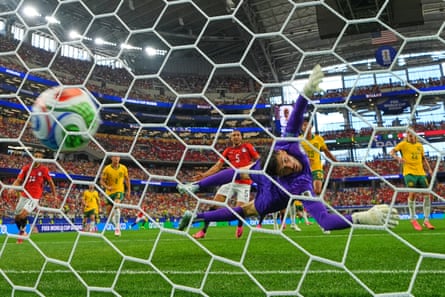
With a bigger tournament came a wider disparity between opponents in the group stage. At the last 32-team World Cup in Qatar, Brazil v Ghana was the biggest group mismatch, with a difference of 60 in their world rankings. In this tournament there were five group games with gaps of more than 65 places. Some of these were competitive – England 0-0 Ghana, Spain 0-0 Cape Verde. But there was little chance of a shock defeat for the big guns, let alone a humiliating group exit like those suffered by holders Spain in 2014 or Germany in 2018. A poor Uruguay were the only major early casualty this time around.
Whereas Costa Rica had the worst goal difference in 2022 (-8), there were five nations who either matched that or did worse in 2026. Iraq (-11) were the whipping boys in Group I – the closest to a group of death as the 48-team format could muster with France, Norway and Senegal, who all progressed in predictable fashion. The more pedestrian group stage did at least offer star names such as Kylian Mbappé and Lionel Messi a chance to gain some real momentum in a memorable race for the Golden Boot.
Flawed third-place system
After the drama of the 2022 group stage, where only two teams (about 6%) were officially out before the final round of fixtures, Fifa changed their plans for three-team groups for the expanded 48-team format and stuck with four-team groups, with eight third-place teams heading through to the last 32. This did not entirely bury the question of collusion between teams nor the fact that those playing later had a competitive advantage in knowing what result they needed to progress.
The quirky side of World Cup 2026 – in pictures
Read more
Knockout opponents could also change in an instant. When Riyad Mahrez put Algeria 3-2 up against Austria in the 93rd minute of the final game in Group J, it meant Algeria would go through as runners-up to play Spain in the last 32. When they conceded an equaliser in the 96th minute, it meant they would face Switzerland on the other side of the draw. Players and fans of third-place finishers like Scotland were also forced to hang around for several days before finding out they were, in fact, going home.
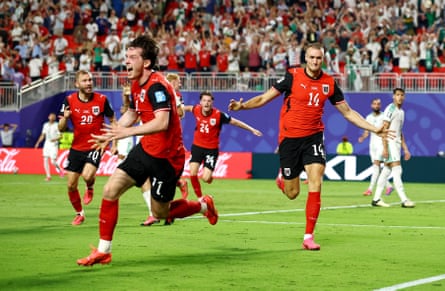
With the shift from goal difference to head-to-head as a tie-breaker, there were five teams (about 10%) already eliminated before their final group game, the third-place system giving an illusion that everything would still be to play for.
What about 64 teams?
Infantino again stressed the importance of organising the World Cup “not just for Europe and South America” when he dropped the hint of an expansion to 64 teams. Adding an extra 16 nations – but only 24 more games – seems like a logical next step for Fifa if they want to do away with the third-place system and return to the top-two-go-through group format. There would at least be some jeopardy, although the disparity within the groups would be even greater.
Nations such as New Caledonia (ranked 151) and Indonesia (118) were involved in late-stage qualifying for the 2026 edition and could make it in with higher quotas. How would they fare against Spain or Argentina? And with the world’s 16 best teams all in the same pot, glamour group ties – which were already in short supply this time – would probably be a thing of the past. England 4-2 Croatia would not have happened with 64 teams.
Then there is the logistical issue of playing four games a day for a three-week group stage – with many matches taking place during the summer daytime heat in Spain, Portugal and Morocco. Of the 23 proposed venues, only the revamped Bernabéu and Camp Nou would have roofs. Further expansion will be a hot topic in the months to come, for sure.
- World Cup 2026
- World Cup
- features
